The future of work: can the tech revolution reboot the employment market?





 1x
1xFifty years ago, if someone had tried to imagine the reality of work in 2025, it is unlikely they would have come close to the truth. Would they have predicted a world of offices filled with computers, all exchanging data via a worldwide web? A world where workers in the ‘gig economy’ can do multiple jobs for different employers in any given week? Or where delivery drivers now comfortably outnumber coalminers?
Peering into the future is a notoriously opaque business. However, the state of the employment market in 2025, together with insights into the cultural and technological changes in progress, seems to offer some clues as to the evolving nature of work in the coming decades.
To get a grasp on the future we must first understand the present. What does the world of work look like right now? In recent times, the concept of work has undergone one of its most radical changes since the 18th Century, or the integration of the female labor force. The cause? A microscopic virus.
The COVID-19 pandemic of 2020/21 caused a global exodus from offices and factories as people sought sanctuary from the contagion in the safety of their own homes. The habit stuck. Around 28% of the global workforce now works remotely some or most of the time, a dramatic increase on the 5% of people who worked from home pre-2020.[1] [2] Some sectors show particular bias towards home working. In the technology sector, for example, 67% of employees now work remotely, often never meeting clients face to face.
It is a trend which, now established, seems unlikely to be reversed. Three-quarters of all workers report feeling happier when they work remotely, and half would actually take a pay cut to maintain that privilege. As a societal shift, remote working is good news for the environment, too. Depending on personal logistics, working from home can cut a person’s job-related carbon footprint up to 80% just by eliminating the daily commute.[3] Employers, meanwhile, can celebrate a reported 13% increase in productivity among home workers, which perhaps explains why around 71% of businesses now offer some form of location flexibility. Capitalizing on the momentum of this newly-dispersed workforce, the global videoconferencing market is tipped to double between now and 2030 to US$ 60 billion.[4] The kitchen table is indeed the new office.
The workplace as a concept has changed forever. But so too has the very nature of the work we perform.
How are job roles changing?
Jobs once familiar are slowly disappearing before our eyes, while a host of new roles are emerging to support our tech-infused Third Millennium lifestyles.
Until fairly recently we had millions of people working as print typesetters, payroll clerks, machine operators, telemarketers and typists. All are now considered rare, or dying, occupations. Newspapers and magazines, with their shrinking circulations, are laid out using design software; computer systems have replaced manual payroll management; machines are now routinely automated and can operate without human intervention; potential customers encounter advertising through pop-up ads or blogs; and dictation software has largely eradicated the need for keyboards and fast fingers.
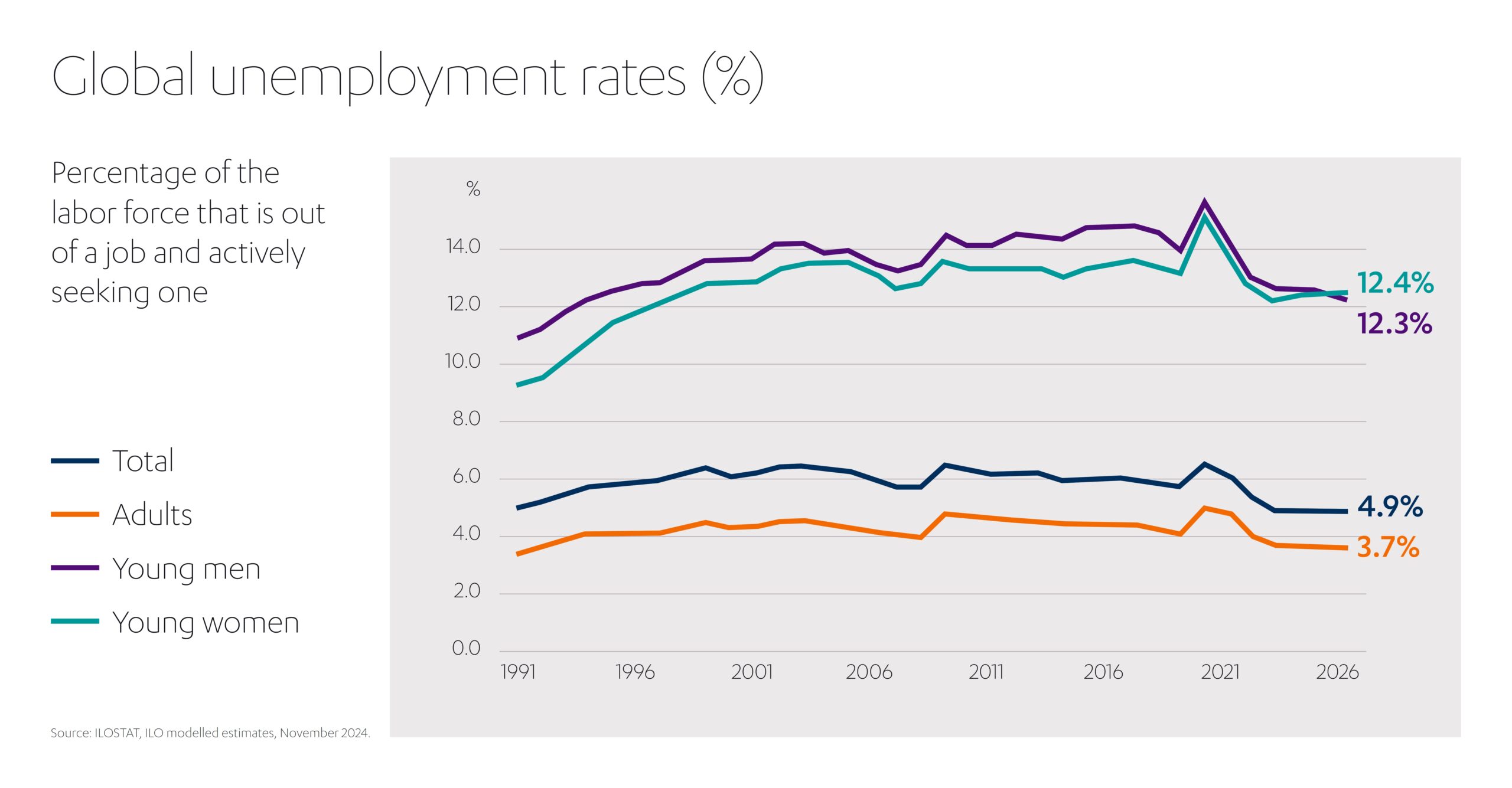
Given these shifts, one could easily imagine lines of unemployed people and worldwide economic turbulence. Tellingly, this is not the case. In fact, the global unemployment rate has remained around a steady 5% since 2020, even as economic growth continues to struggle (3.6% in 2022, 3.3% in 2023 and 3.2% in 2024).[5]
The truth, as we venture boldly into our sparkling new digital age, is that whole new categories of jobs are emerging to replace those rendered obsolete. This is more than just anecdotal observation: The International Labor Organization (ILO) estimates around 53 million new jobs will be created in 2025 alone.[6]
What might these jobs look like? Some of them are familiar roles which will be needed in far greater numbers to meet the demands of social trends; others are emerging disciplines necessary to maintain our new technological paradigm.
Web development, a job recognized since the 1990s, remains highly regarded as companies strive to differentiate themselves from rivals online. As programming languages evolve and merge with the growing opportunities offered by artificial intelligence (AI), roles in web development could grow an additional 23% by 2030.[7]
Average lifespans are predicted to lengthen a further five years by mid-century. To meet the needs of an ageing population, we will need legions of new home health practitioners in our communities to provide personal care and perform household chores. The number of home health professionals could expand 25% by the end of the decade. Occupational therapists, helping those with health challenges live independently, will undergo similar growth. The number of nurses could soar more than 40%, driven by widening access to healthcare and personalized AI-led treatment plans.
Recent history has shown how vulnerable we are to disease, so epidemiology is likely to be another growth area, with an anticipated 26% expansion of jobs by 2030. Many experts believe another pandemic is inevitable, citing global population growth and the ongoing urbanization of animal habitats raising the chances of zoonotic (animal-to-human) disease transmission.
It is widely acknowledged that we are in the early days of catastrophic climate change, catalyzed by our global addiction to fossil fuels. Renewable energy sources must account for at least 90% of the world’s energy mix by 2050 to keep alive the 1.5 degree warming limits set out in the 2015 Paris Climate Agreement. Solar PV installers and technicians will prove vital for this energy transition, with jobs in this sector tipped to rise a further 27% by 2030. The number of turbine technicians, likewise central to the renewable journey, could rise 44% in the same timeframe.
Information security specialists will help protect our privacy as more aspects of our lives migrate online. With a rise in online scams, cyberattacks and data hacks, those tasked with guarding our finances and personal data will become much sought after. By 2030 the number of information security specialists could rise as much as 35%.
Data scientists – those responsible for extracting meaning from the mass analyses enabled by AI – will be highly prized. There will be 36% more data scientists by 2030, according to estimates, together responsible for interpreting performance metrics, guiding decision-making and enhancing profitability at corporations worldwide.
Physical frontline roles – agricultural workers, builders, delivery drivers – are also expected to multiply as humans continue to conduct nuanced tasks which robotic equivalents cannot yet hope to match.
The dominant job trends are driven by an emerging technology which has rarely been out of the headlines in recent years, and which will soon play a ubiquitous part in all of our lives – AI.
How is AI reshaping the workplace?
AI’s impact on the jobs market over the coming decade will be little short of seismic. The sector is surging financially, likely to grow from US$ 244 billion today to more than US$ 800 billion by the end of the decade.[8]
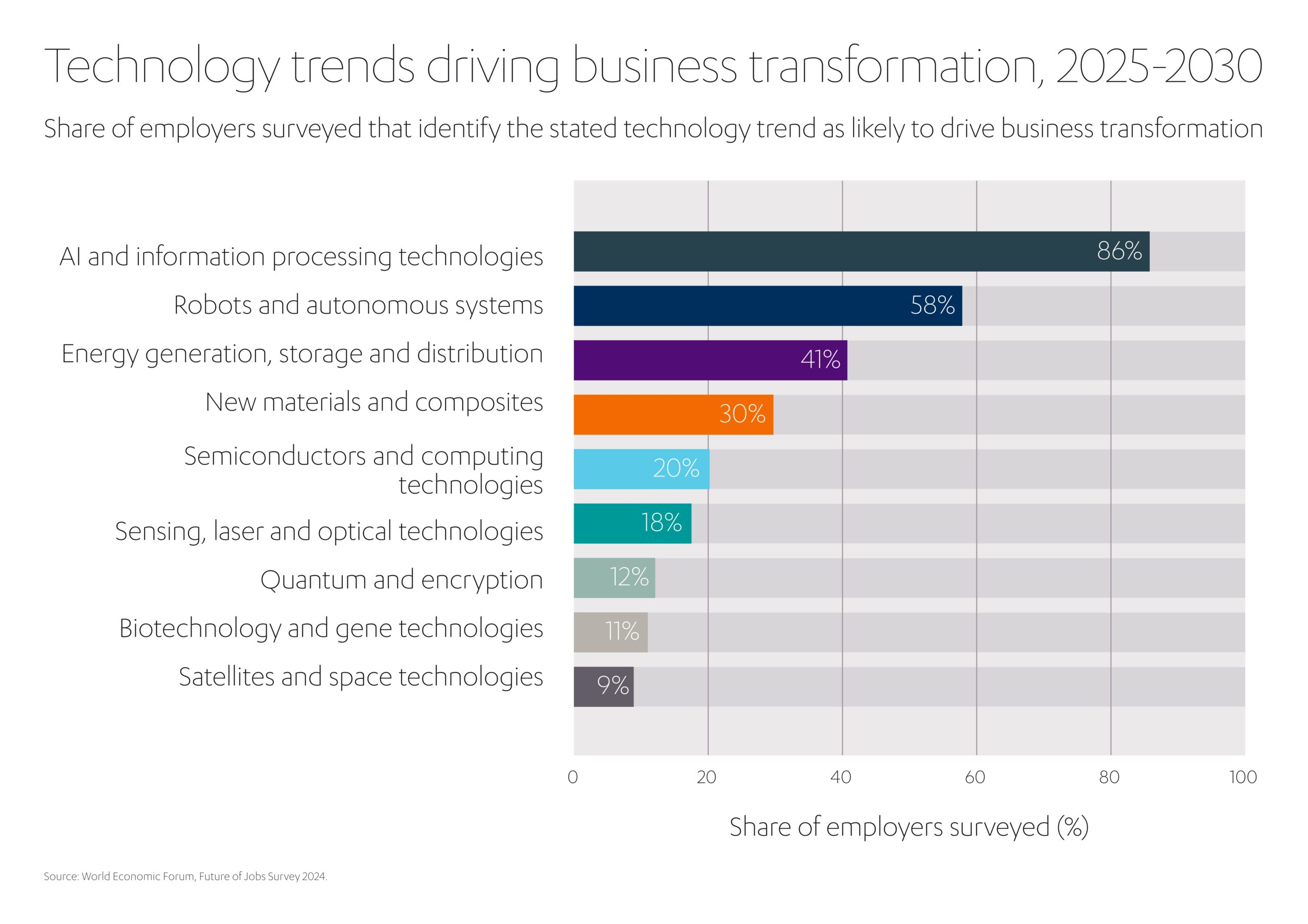
In a World Economic Forum (WEF) survey of corporate leaders, some 86% identified AI as the most transformative trend affecting their businesses in the near- to mid-term future.[9] Indeed, the three fastest-growing skillsets in the workplace are expected to converge around technological literacy, big data and cybersecurity.
AI is, of course, an umbrella term for a number of closely-related technologies. As such, we can anticipate whole new career pathways developing across multiple disciplines: Financial technology (fintech) engineers, machine learning specialists, app developers, data experts, electric vehicle technicians, prompt editors for generative AI, and a worldwide community of imagineers whose niches have yet to be conceived.
On one hand, the prognosis is troubling. AI could potentially trigger more than 90 million redundancies by 2030[10] and eventually assume a quarter of all work tasks in mature economies like Europe and the USA.[11]
Offsetting these losses, armies of specialists will suddenly become essential across a range of emerging specialisms: Natural language processing, deep learning, computer vision (helping computers ‘see’ images like a human eye), and content creation. In some forecasts AI actually incubates 170 million new jobs by 2030 – a net win for global employment.[12]
As the lifeblood of many future occupations, AI must also inspire a fundamental pivot to digital skills in training and education. With whole new disciplines involving computer interface, ‘button knowledge’ – an understanding of how to interact with and manipulate applications – will prove a basic requirement.
Beyond this baseline, people with a comprehension of the ‘inner workings’ of software (the code lying behind the user experience) and an awareness of algorithmic logic will forge new professional pathways. As time passes, we will need more people fluent in social media, cyber asset protection, blockchain technology, digital marketing, data analysis, and the emergent field of AI ethics.
Aside from technical talents, digital skills can also encompass something rather more human: An ability to transform data into knowledge, and use that knowledge to unlock strategic, informational and communication benefits. People with these holistic skills will be the visionaries and leaders of tomorrow.
We have already seen that the jobs market is primed for a tech-driven reboot. It requires no great leap of faith to imagine networks of remote colleagues united by digital collaboration tools, real-time communication software and cloud-based data storage. However, what about the culture of work itself, and the day-today realities of earning a living in a fast-changing world?
Is ‘gig work’ a temporary feature or a sign of the times?
In 2025 the concept of the 9-5, five-days-a-week, job-for-life already seems quaint. Today’s labor force can be portrayed as nimble and versatile – or high-turnover and notoriously insecure.
The so called ‘gig’ economy, chiefly manifesting as short-term, freelance, or temporary work, is the new normal for many people around the world. It is characterized by one-off or rolling arrangements between individuals and third-parties to fulfil a range of specific tasks or services: From delivery drivers to dog walkers, caregivers to consultants, web developers to window cleaners. Increasingly, gig workers are matched with customers via one of a number of emerging freelance platforms. Upwork, Fiverr, PeoplePerHour, Shopify, Uber, Lyft, TaskRabbit and more have all exploded from drawing board to household name within the space of a few years.
The gig economy is big business. In 2024 it reached a market size of US$ 556 billion, a figure set to balloon to more than US$ 1.8 trillion by 2032.[13] According to estimates, at least a third of workers in America now identify as independent operators.
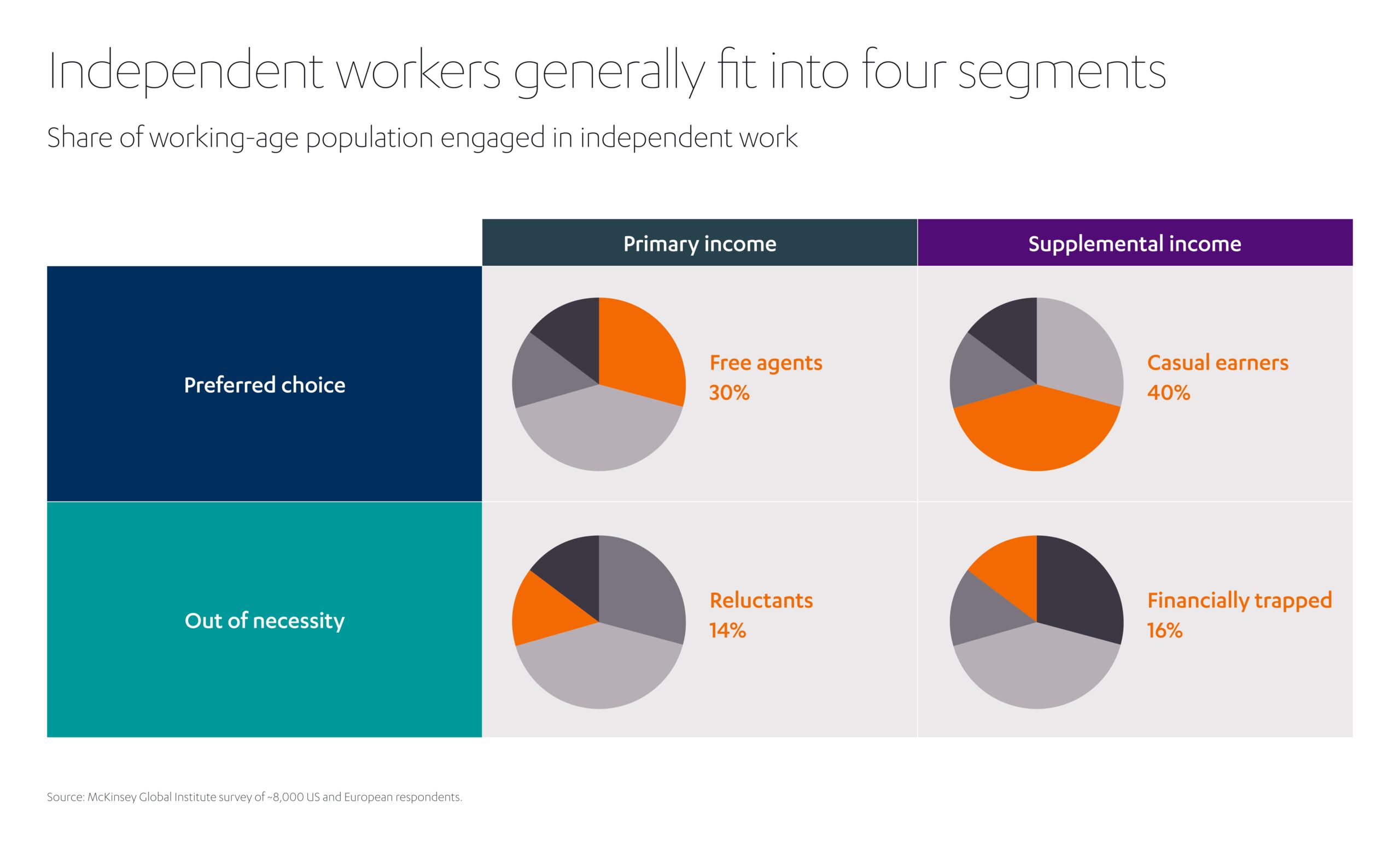
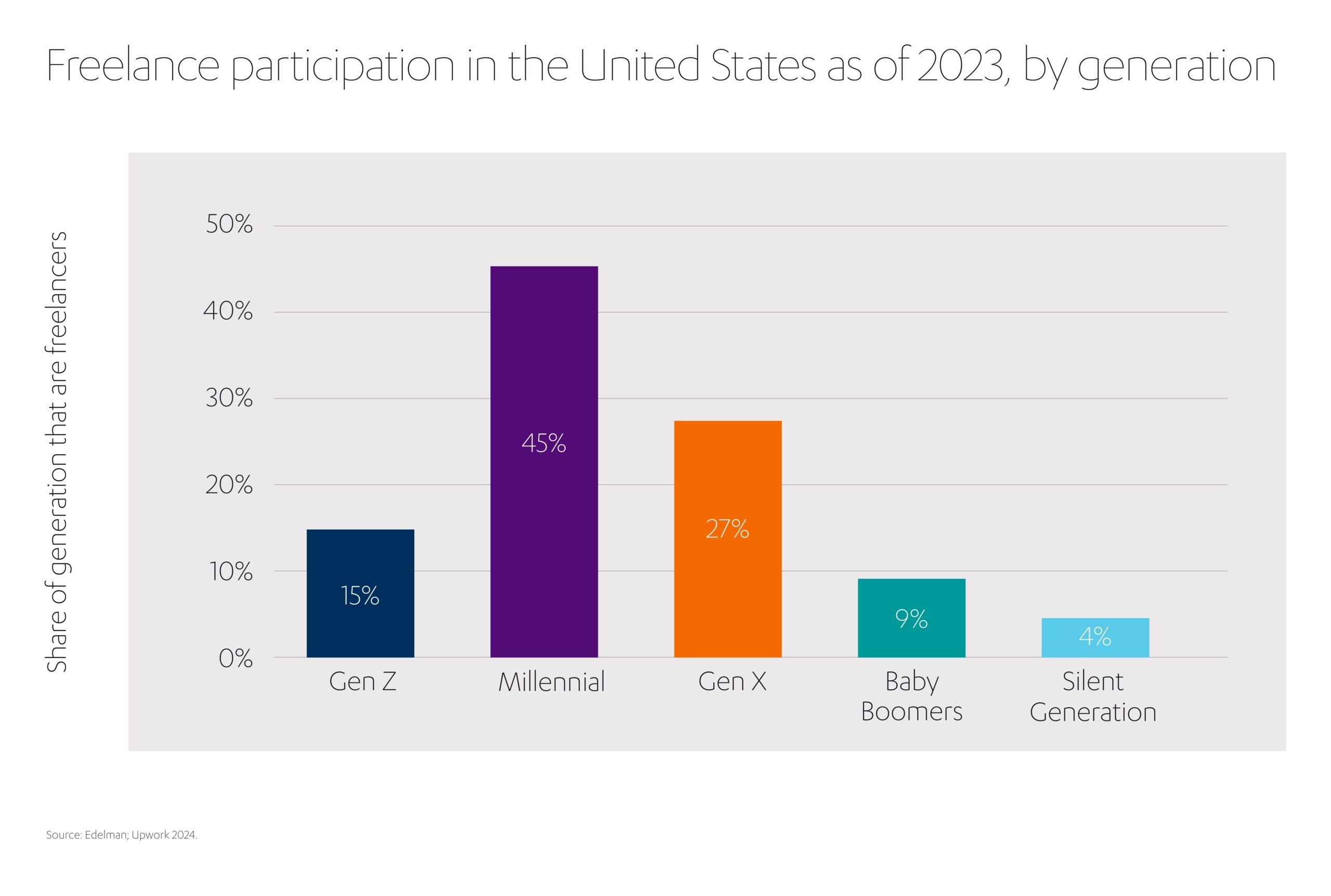
Is the gig economy to be encouraged? That is another matter. Up to 30% of gig workers say they only work in that sector out of necessity, either as a primary income or to supplement a second role elsewhere. Usually these positions lack many of the benefits associated with traditional employment. There are no paid holidays, minimum wages, career development programs, medical cover or pension options. Lack of job security can affect a gig worker’s ability to take out a loan or find a mortgage, potentially keeping them trapped in a cycle of low pay and second-class citizenhood. The generational divide is profound, with 45% of millennials having worked in the gig market compared to just 9% of people born in the 1960s.[14]
Court cases are ongoing around the world to help establish basic rights for gig workers. Notably, the UK’s Supreme Court ruled that Uber drivers should be treated not as independent contractors but as workers, and were entitled to be paid for their time irrespective of ride demand. In California, the world’s fourth largest economy, the AB5 law is helping to establish parity between gig workers and full-time staff by enshrining rights such as overtime pay and insurance cover.
Some evolutions are more grassroots in nature. International campaign groups like the Gig Workers Alliance are pushing for collective action to protect employment rights. They are urging innovative solutions such as portable benefits systems spanning multiple contracts, allowing gig workers to accrue benefits in the same way as staff members.
With 80% of large corporations planning to increase their proportion of flexible workers in the near future, such legislative moves will set precedents for generations to come.[15]
The insecurity inherent in a gig economy could be partially offset by another concept gaining traction – the Universal Basic Income (UBI).
A UBI is a non-means tested minimum payment given to all citizens regardless of work status. It enables them to remain above the poverty line and fund the essentials of life such as food, accommodation and medicine.
Theoretically this frees up people’s time to concentrate on activities that bring less quantifiable benefits, such as volunteering for good causes, or exploring the creative arts, or restoring the environment.
Critics fear such a system would be economically unfeasible and lead to fewer people opting to work. However, with AI predicted to master 59% of tasks currently performed by humans within five years, a fully-fledged UBI system could be the spur we need to redefine what we consider a valuable investment of time.
More than a hundred countries have experimented with some form of UBI, including Mexico, Iran, Kenya and Italy, but always confined to pools of people numbering in the hundreds or thousands. It has yet to gain widespread acceptance, even though research suggests such systems can elevate happiness, reduce crime, improve health, boost work attendance and improve trust in public institutions.[16]
However the future of work transpires, we must strive to ensure one guiding principle: That no one gets left behind.
Why economic systems must work for everyone
There is little time to waste in planning for the next-generation jobs market. Given the technological and social shifts on the horizon, almost 60% of workers will need upskilling or reskilling by 2030 to remain professionally relevant.[17] With an ageing global population, buoyant GDPs are urgently needed to support a demographic that is no longer able to contribute financially to society.
Crucially, we must make sure the jobs transition works for everyone. Disparities already exist in the global jobs market which, if allowed to become embedded, could threaten community cohesion, reinforce inequality and undermine the social contract.
Young people, for instance, are disproportionately unemployed. Around the world 12.4% of young men and 12.3% of young women are involuntarily jobless, far outpacing the 5% average.[18]
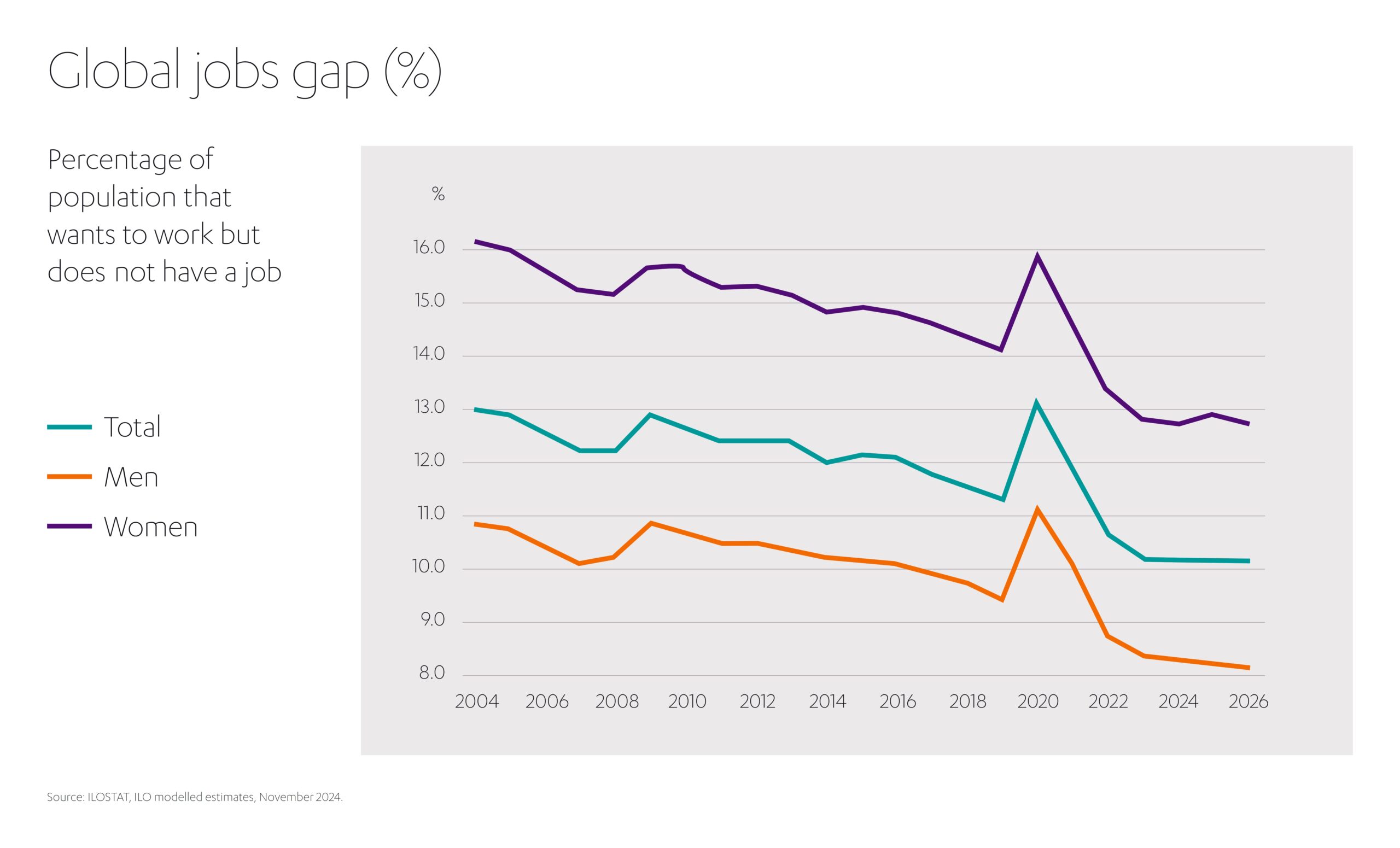
As we strategize for future employment trends, we must also ensure positive choices for women. Although the global jobs gap has shrunk since 2000, a gulf remains between men and women. As of 2024, 12.8% of women are unwillingly jobless compared with just 8.3% of men.
The emergence of new technology and the dawn of AI offer us an unparalleled opportunity to reevaluate the notion of work and reorder our priorities. Looking ahead, will more of us work to live rather than live to work? The decisions being made now in boardrooms and legislative chambers will impact prosperity for decades to come.
Just as many jobs from 1975 would appear alien to modern eyes, fifty years from now the labor market may have undergone yet another quantum leap and be unrecognizable again. As for ensuring these changes unfold for the wider public good? That will take wisdom, cooperation… and work.
Fast facts: What is the future of work?
Q: How much has remote work grown since the pandemic?
A: Remote work has increased dramatically from just 5% of people working from home pre-2020 to around 28% of the global workforce now working remotely some or most of the time.
Q: How many new jobs will be created in 2025?
A: The International Labor Organization estimates that around 53 million new jobs will be created in 2025 alone, despite technological disruption eliminating many traditional roles.
Q: Which job sectors are expected to see the highest growth by 2030?
A: Wind turbine technicians (44% growth), nurses (40% growth), information security specialists (35% growth), and data scientists (36% growth) are among the fastest-growing occupations.
Q: What percentage of workers will need reskilling by 2030?
A: Almost 60% of workers will need upskilling or reskilling by 2030 to remain professionally relevant due to technological and social shifts.
Q: How much could AI be worth by 2030?
A: The AI sector is expected to surge from US$ 244 billion today to more than US$ 800 billion by the end of the decade, with 86% of corporate leaders identifying AI as the most transformative business trend.
[1] https://www.statista.com/topics/6565/work-from-home-and-remote-work/#topicOverview
[2] https://www.forbes.com/sites/gadlevanon/2020/11/23/remote-work-the-biggest-legacy-of-covid-19/
[3] https://www.strongdm.com/blog/remote-work-statistics
[4] https://neat.no/resources/top-remote-work-statistics/
[5] https://www.ilo.org/resource/other/world-employment-and-social-outlook-trends-2025-figures
[6] https://www.ilo.org/resource/news/global-employment-forecast-downgraded-7-million-jobs-2025-amid-rising
[7] https://finance.yahoo.com/news/20-most-demand-jobs-future-073358127.html
[8] https://www.statista.com/topics/3104/artificial-intelligence-ai-worldwide/#topicOverview
[9] https://reports.weforum.org/docs/WEF_Future_of_Jobs_Report_2025.pdf
[10] https://www.mckinsey.com/capabilities/mckinsey-digital/our-insights/superagency-in-the-workplace-empowering-people-to-unlock-ais-full-potential-at-work
[11] https://www.nexford.edu/insights/how-will-ai-affect-jobs
[12] https://www.mckinsey.com/capabilities/mckinsey-digital/our-insights/superagency-in-the-workplace-empowering-people-to-unlock-ais-full-potential-at-work
[13] https://www.weforum.org/stories/2024/11/what-gig-economy-workers
[14] https://www.weforum.org/stories/2024/11/what-gig-economy-workers
[15] https://velocityglobal.com/resources/blog/gig-economy-statistics/
[16] https://www.vox.com/future-perfect/2020/2/19/21112570/universal-basic-income-ubi-map
[17] https://www.weforum.org/publications/the-future-of-jobs-report-2025/digest/
[18] https://www.ilo.org/resource/other/world-employment-and-social-outlook-trends-2025-figures


 Added to press kit