Going underground: does the solution to the energy crisis lie beneath our feet?




This year, something quietly remarkable happened in Cornwall, UK – or at least, 5 kilometers below the surface.
A revolutionary engineering company finished drilling the deepest on-shore well the country has ever seen and switched on the UK’s very first geothermal power plant. Just like that, 10,000 British homes began receiving clean energy from an endlessly renewable 24/7 source, saving thousands of tons of CO2 emissions annually.[1]
The United Downs Deep Geothermal Power Project, mastered by Geothermal Engineering Ltd (GEL), is a US$ 65 million technological marvel. Like all geothermal plants, it draws on heat stored beneath the planet’s surface generated by radioactive decay, a natural process which has endured since the Earth’s formation. Water is piped down a well where it percolates through natural fissures in rocks of temperatures approaching 200oC. This super-heated water is then pumped back up to the surface where it is used to rotate turbines and create energy for export via the grid.
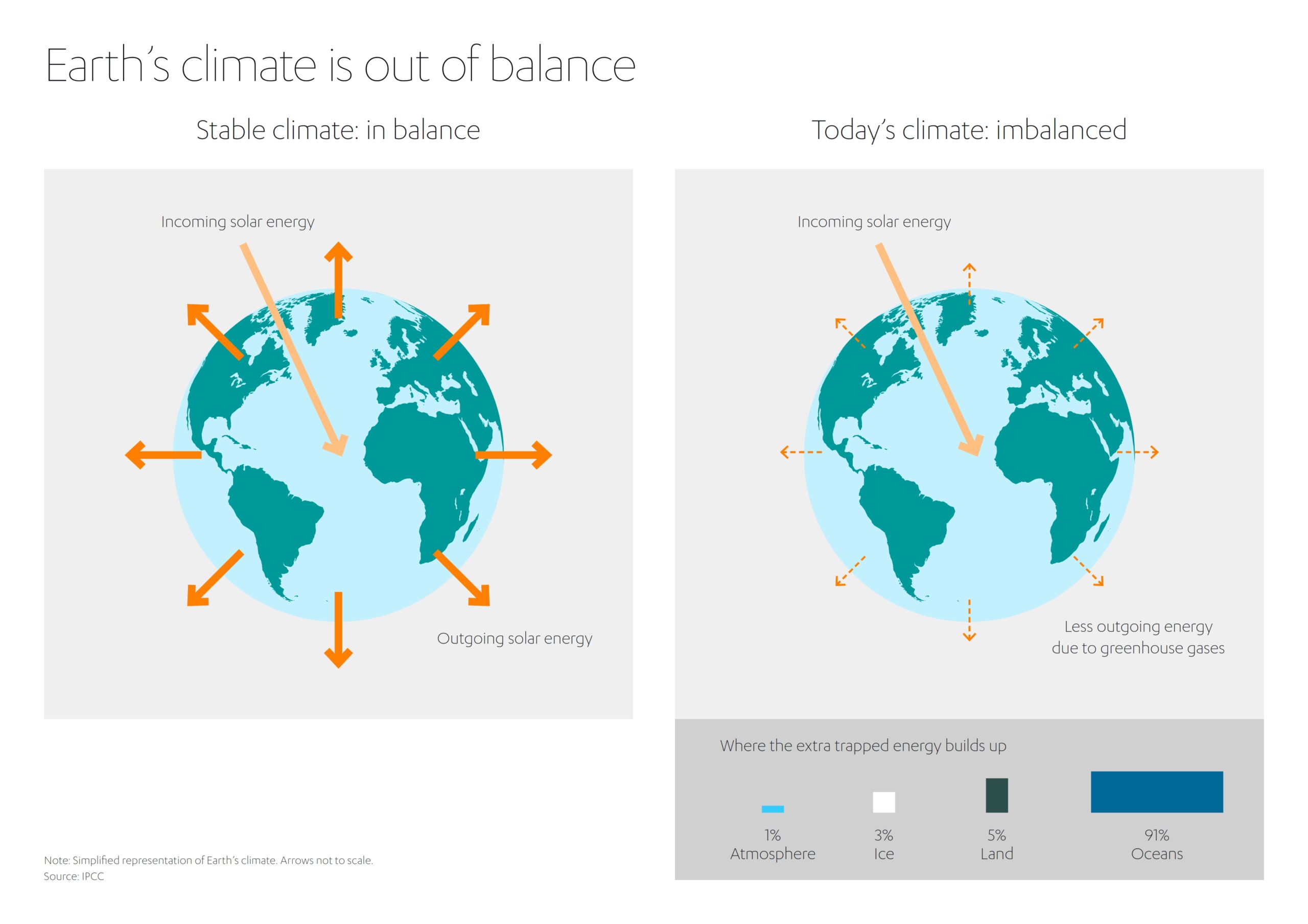
It is the latest landmark in the world’s booming geothermal energy sector. And as a low-carbon source of power, its timing could hardly be better. In March 2026, the World Meteorological Organization stated that the Earth’s climate was further out of balance than ever before, accumulating far more heat energy than it can release in return.[2] This imbalance, caused by greenhouse gases trapping heat in the biosphere, is leading to faster glacier melt and sea level rises, with new record temperatures predicted for later this year.
With work completed at United Downs, GEL is now looking to develop two additional geothermal energy plants. It is far from alone in seizing on the momentum of geothermal energy, a sector which is generating heat in every sense of the word.
Is geothermal energy about to go mainstream?
The International Energy Agency (IEA) reports that investment in advanced geothermal technologies is growing sharply, totaling US$ 2.2 billion worldwide in 2025, up 80% year-on-year since 2018.[3] This investment in the sector’s ‘technologies of tomorrow’ is in addition to the US$ 5 billion sourced for conventional geothermal power projects in 2025, and a further US$ 11.5 billion secured for district geothermal heating plants.
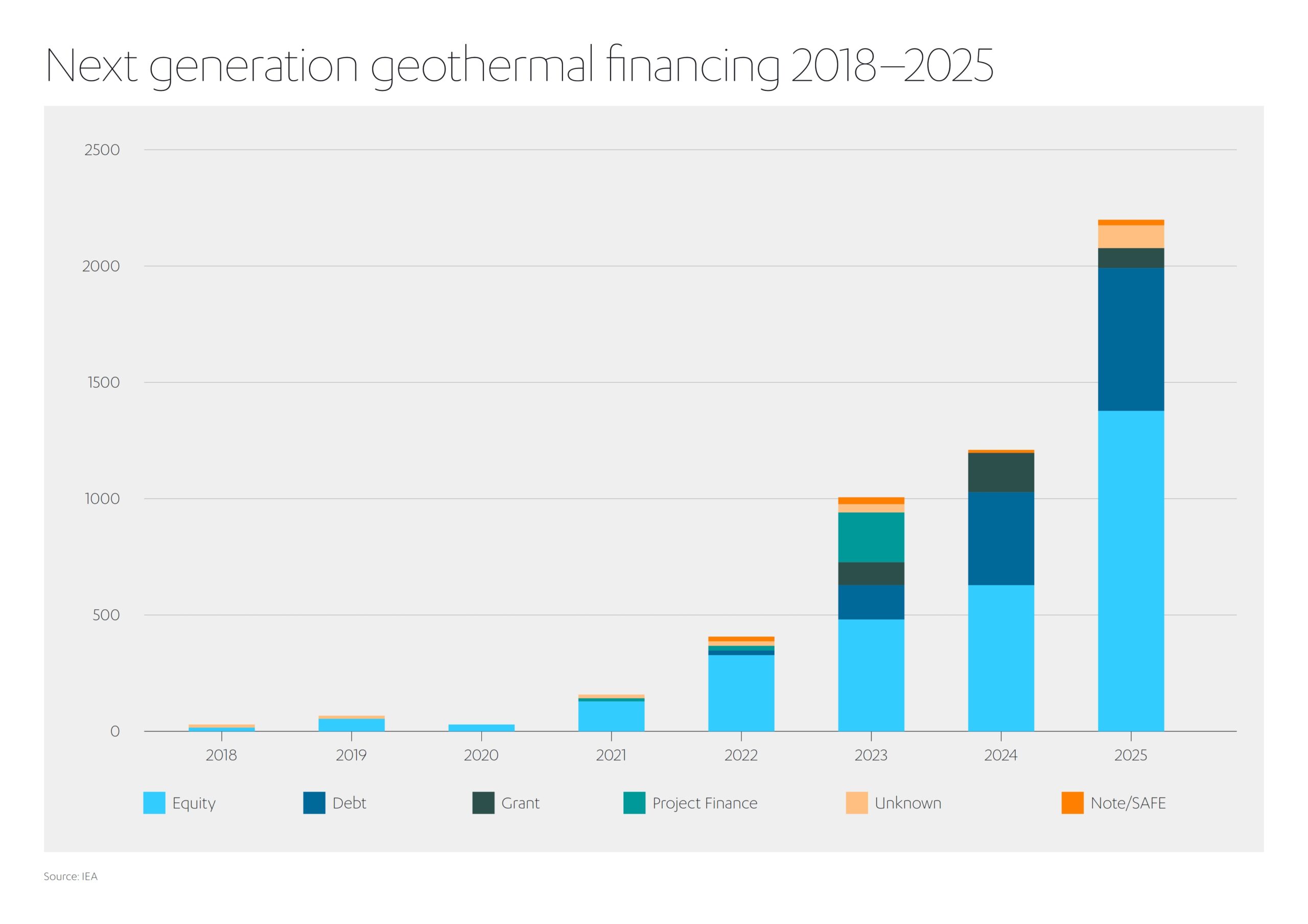
Surging investment, the IEA says, is partly down to the growing demands of technology companies who need huge amounts of reliable electricity to feed energy-hungry data centers.
In addition to multiple megawatts of energy, geothermal plants offer a secondary benefit for tech firms – the potential to send excess heat from data centers straight back underground, rather than letting it radiate into an already stressed atmosphere.
What is the potential for geothermal energy?
At present, geothermal plants remain largely confined to a small number of shallow access points worldwide. As such, geothermal energy is currently responsible for only around 1% of global electricity generation. But all that may be about to change.[4]
Assuming the trajectory of technological refinements continues, the IEA anticipates that geothermal energy could satisfy up to 15% of the world’s electricity demands by mid-century. This would equate to some 800 GW of geothermal capacity worldwide, generating power equivalent to the current energy demand of the USA and India combined.[5]
Following the examples of Kenya (where geothermal energy provides 40% of the current energy mix) and Iceland (around 30% of electricity and 90% of heating), other countries are now leaping on the geothermal bandwagon.[6]
According to a report from the MIT Energy Initiative, Türkiye, New Zealand and Indonesia are all prioritizing geothermal expansion as part of broader energy strategies, driven by an influx of private capital and shifting environmental policies. Favorable geology helps, with all these countries rich in volcanic activity and vast subsurface resources, making them ideal for geothermic exploitation. Even in the USA, with a current administration outwardly ambivalent to green issues, bipartisan legislation is promoting research and development of advanced geothermal technologies based around superhot rocks.
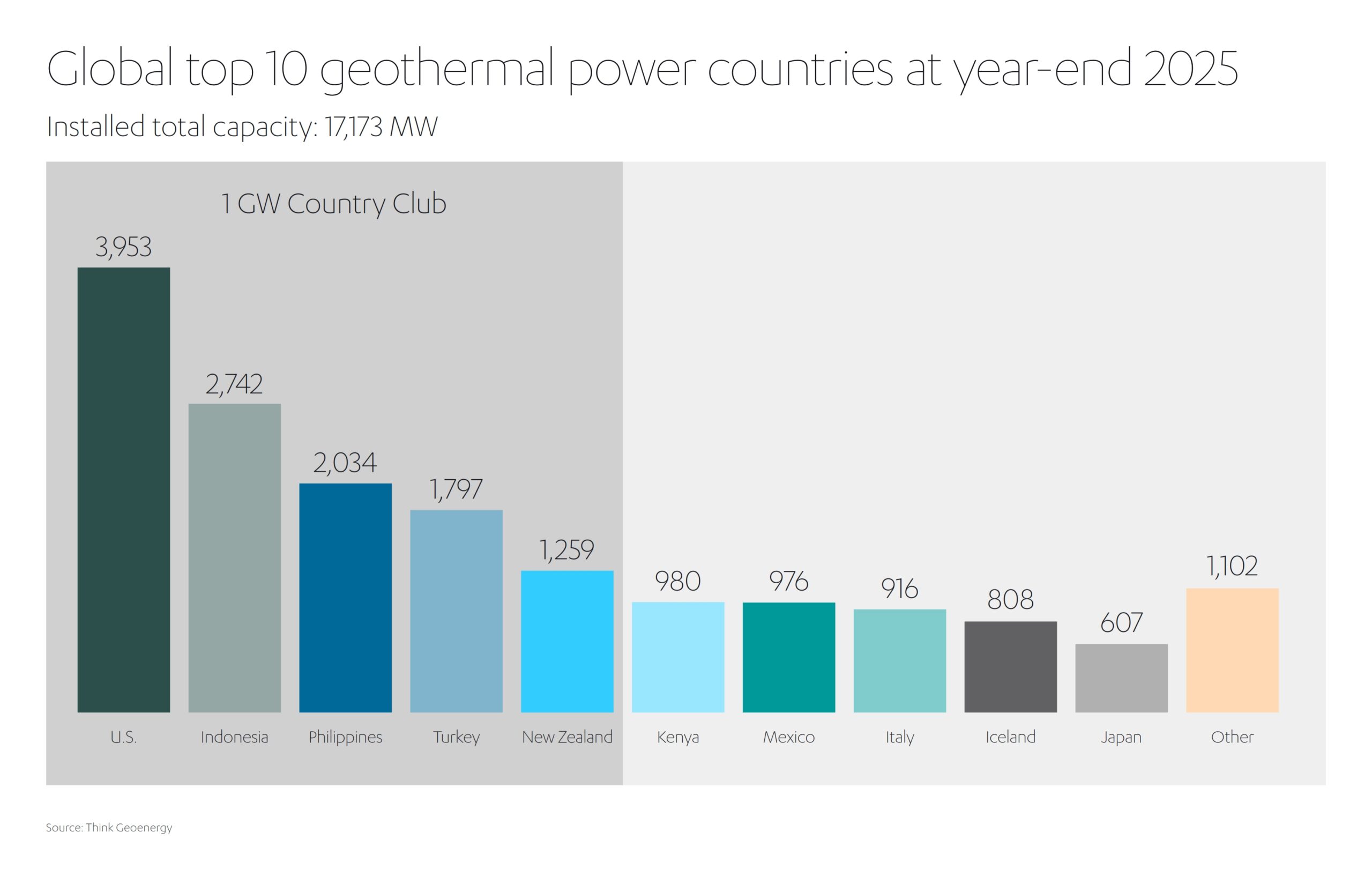
By the end of 2025, installed geothermal energy capacity reached 17,173 MW worldwide, an increase of 223 MW over the previous 12 months.[7] The USA remained the world’s largest single geothermal energy producer at 3,953 MW, although without any new major commissions. Rounding out the top five are a host of countries which did significantly expanded their geothermal capacity during 2025, including:
- Indonesia (2,742 MW): With new generation from the Ijen Unit 1 project, Lumut Balai Unit 2, and a binary unit at Salak, Indonesia is now the fastest growing geothermal market worldwide.
- The Philippines (2,034 MW): New capacity included the Tanawon binary geothermal plant at the BacMan II complex.
- Türkiye (1,797 MW): Europe’s largest producer of geothermal energy commissioned three new geothermal plants: Emir, Hez Morali, and Nezihe Beren Unit 2.
- New Zealand (1,259 MW): A new geothermal plant known as TOPP 2 had not officially connected to the grid by the end of 2025, but test operations had commenced.
Elsewhere in 2025, Iceland’s expansion of its Svartsengi geothermal plant added 22 MW of new capacity. In Central America, El Salvador added an 8 MW binary unit at its Berlin geothermal field. Looking ahead, industry forecasters expect to see significant growth across the sector in 2027 as advanced geothermal projects move towards scalable deployment.
Something is clearly driving this recent surge in the global geothermal energy market. Unsurprisingly, technology is the answer.
How is technology transforming geothermal energy?
Innovation is the driving force behind the next generation of geothermal energy plants.
Geographically, the current geothermal energy industry is largely clustered around the edges of tectonic plates. However, a number of new technologies – some exploiting the deep drilling specialties of legacy oil and gas industries – could widen the sector’s scope to almost anywhere on Earth.
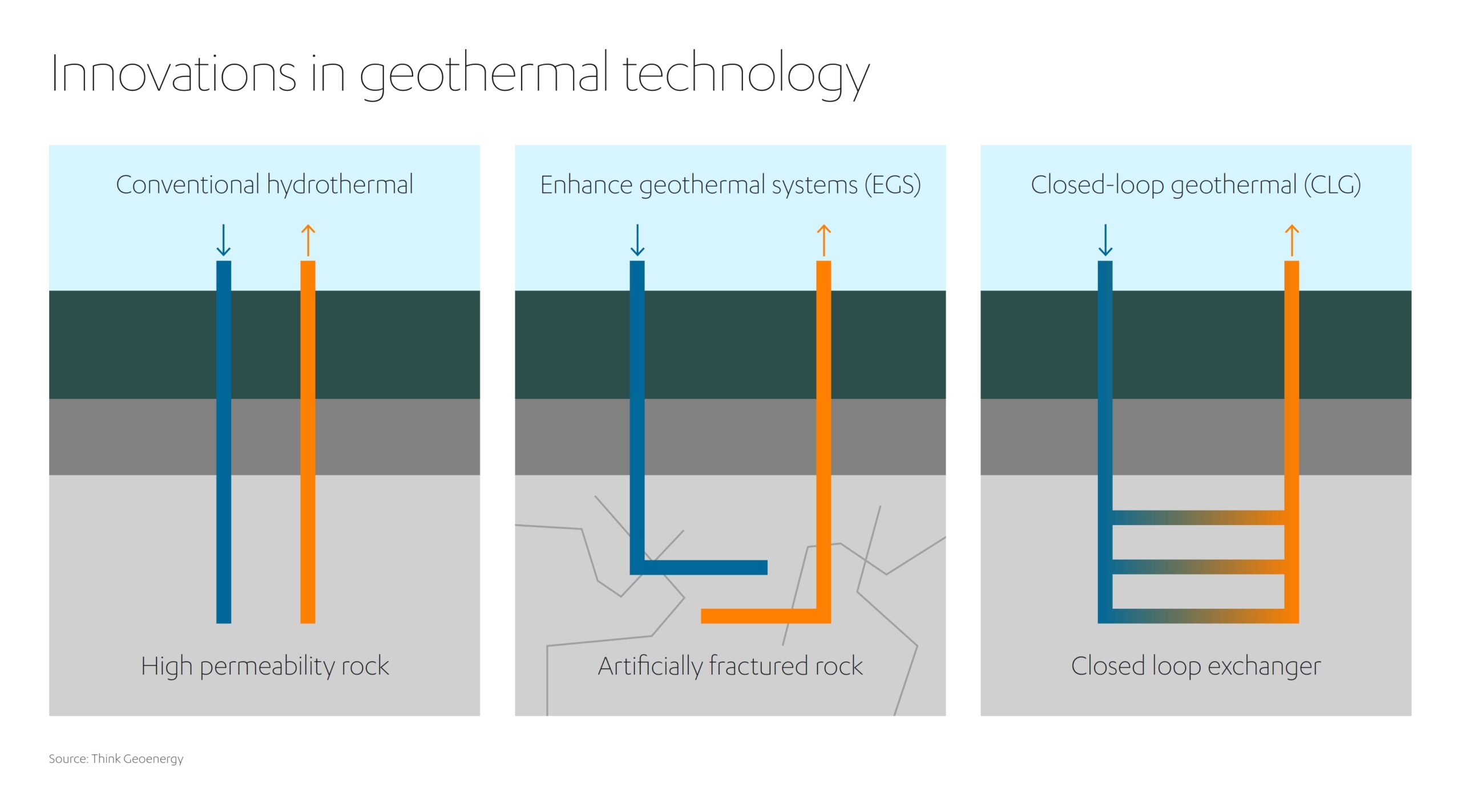
The two main emerging geothermal technologies are Enhanced Geothermal Systems (EGSs) and Closed-Loop Geothermal Systems (CLGs).
How do enhanced geothermal systems function?
EGS systems aim to open up vast new swathes of the Earth’s crust for geothermic exploitation by increasing the permeability of super-hot, super-hard rocks. This entails drilling deep wells and artificially expanding natural fissures or even creating new ones. Three methods are currently being investigated:
- Hydraulic stimulation: Injecting fluids at high pressure into underground rock to form new fractures, permitting the ready flow of fluid and heat
- Thermal stimulation: Weakening masses of rock by pumping in cold fluids to trigger thermal shocks caused by rapid temperature changes
- Chemical stimulation: Creating new underground holes by circulating chemical compounds (such as acids) through rock layers to attack specific minerals and encourage them to dissolve
Whichever method is used, the end result is a network of deep subterranean cracks through which water can pass, absorb heat, and be pumped out as steam. More than 30 EGS projects have been trialed worldwide, in locations spanning Europe, Asia and Australia.[8] Fervo’s Project Red[9], in Nevada, for example, is demonstrating the effectiveness of multi-stage stimulation techniques to increase reservoir volumes and heat transfer areas. Elsewhere, developers are experimenting with horizontal wells, which although harder and more costly to drill than conventional vertical wells, can maximize exposure to hot rock strata.
New EGS projects are coming online regularly. In the USA, Fervo’s 400 MW, 2.4 kilometer deep Cape Station project in Utah[10] is due to start operating later in 2026. In Switzerland, Geo-Energie Suisse’s existing Haute Sorne project[11] is set to expand with a second well in 2026 ready for commercial generation by 2029.
Future EGS innovations in drilling and rock disruption could further open up previously inaccessible crystalline basement formations. These deeply buried zones of impermeable rock have the benefit of extraordinarily high temperatures, sometimes exceeding 375oC, lifting energy outputs considerably.
EGS even has a future as a storage mechanism for excess energy from solar and wind. Surplus energy can be held in the form of hot water or steam, ready for deployment when renewable sources are not available. In some cases, geothermal storage efficiencies could exceed those of lithium-ion batteries.[12]
What are closed-loop geothermal systems?
Closed-loop geothermal systems, or CLGs, are equally exciting. These involve drilling and sealing a large, artificial loop deep underground. Fluid passing through the system is heated via conduction from surrounding rocks, without ever coming into direct contact. They do not require the stimulation of subterranean rocks and reservoirs, and output is more consistent compared to the organic pathways utilized by EGSs.
CLGs bring one significant technical drawback, however. Since conduction is a slower way to transfer heat than direct contact, drilling distances must be considerably longer, sometimes several times the length of EGS equivalents. This translates to higher costs, which perhaps explains why CLGs are lagging behind EGSs in terms of rollout.
Still, CLG demonstration projects are active in Canada, Europe and the USA. GreenFire Energy’s GreenLoop scheme in California[13], for example, outputs fluid at 180°C for 1.2 MWe of energy generation. An upcoming CLG project in Germany aims to prove the commercial case on an altogether grander scale. Eavor’s €350 million Eavor-Loop project in Geretsried, Bavaria[14], is scheduled for completion in 2027. This facility, which acts like a giant radiator, features four underground heat exchangers and around 320 kilometers of vertical wells and lateral connectors. With an anticipated energy output of 64 MWth / 8.2 MWe, when complete it will supply the entire region with heating and electricity, saving approximately 44,000 tons of CO₂ emissions annually.
For each of these new technologies, depth matters. At depths of around 2,000 meters, only a select few locations worldwide are commercially feasible for EGS and CLG deployment, but expand the depth to 4,000 meters and huge swathes of Africa and Asia also become viable.[15] Venture down further, to 7,000 meters, and few areas of the world are excluded from the geothermal energy map.
How are innovations in drilling technology transforming geothermal energy?
With every extra meter making a disproportionate difference to output, the development of highly-evolved drilling technologies becomes the central component of a widespread geothermal energy industry.
One such innovation is a millimeter-wave drilling kit developed by MIT’s Plasma Science Fusion Center (PSFC). This uses microwave energy to vaporize rock, a strategy that is proving several times faster than regular drilling, particularly in deep installations at extreme temperatures.[16]
Acknowledging the impact that further breakthroughs in drilling could have on global energy supplies, the PSFC is currently developing a new facility to test rock samples 500 times larger than currently possible. By super-sizing their testing capability, researchers will be able to explore how rock behaves at scale, considering variables such as permeability, porosity and borehole stability. The new laboratory will examine upcoming technologies like durable waveguides (metallic tubes that guide gyrotron-generated energy to melt tough crystalline rock), high-power RF transmission and next-generation magnets.
Researchers are also developing a new type of sensor to measure micro-cracks in high-pressure rock, as well as advanced alloys (far cheaper than costly titanium) to handle superhot liquids, and special coatings to protect pipes from corrosive geofluids.
This pipeline of technical innovation is vital for geothermal to fulfil its potential, given the challenges that continue to constrain the industry.
Rocky road: What are the challenges around geothermal energy?
Whether relying on conventional, EGS or closed-loop systems, any action subjecting subterranean areas to stress has the potential to induce seismicity and damage infrastructure – events that are bound to trigger local opposition and jeopardize future geothermal schemes.[17] Seismic events have already caused projects to be suspended, most recently in Pohang, South Korea, following a 5.4 magnitude earthquake in 2017.
Research is ongoing to counter these risks, producing insights that should improve safety. One study, for example, showed that pumping fluid into existing low-permeability faults can trigger more seismic activity than creating new fracture networks – a vital distinction when planning future sites. Micro-seismicity monitoring, meanwhile, makes it possible to stimulate underground reservoir zones in sequences designed to limit the accumulation of tremors.
The duration and cost of drilling continues to inhibit wider rollout of geothermal energy. Because of the technical complexity of boring into the ground, geothermal projects take longer to commercialize than oil and gas schemes and carry higher upfront costs.
What can be done? Expertise is being sought from the fossil fuel industry to reduce the cost of geothermic drilling, either by increasing penetration speeds, or improving the durability of drill-bits, or optimizing supply chains to cut downtime. In superhot rock systems, equipment is exposed to hostile conditions, with breakdowns a persistent problem. Operators can help protect kit from temperature extremes by using polycrystalline diamond bits, running cooling fluids during drilling, or fitting ‘mud chillers’. High-pressure water jets are also being tested which can accelerate drilling rates by blasting rock into specific shapes that can be broken down more rapidly by fluid-driven hammers.
The constant flow of liquid and steam through a system brings inherent mechanical challenges, too, with acidic components degrading surfaces. In response, research is under way into heat-resistant downhole equipment. Adapted tools and samplers, purpose-built to withstand high temperatures and corrosive conditions, are beginning to appear on the market, alongside robust optical fibers for taking accurate measurements. New software is also being developed to map a geothermal reservoir’s potential via flow and pressure-transient tests.
Time is another hurdle, with geothermal projects often taking a decade or more to navigate the permissions pathway. Investors are naturally wary of such a protracted journey to profitability. Now, industry bosses are campaigning to ease the administrative burden, by consolidating the steps involved and introducing geothermal-specific application processes separate from standard mineral mining protocols. A greater legislative effort is doubtless required worldwide; only 30 countries at present have established policies governing geothermal energy, compared to 100+ countries for solar and wind power.[18]
Pursuing solutions to these technological and logistical limitations could make geothermal energy a significant contributor to the planet’s future energy mix.
Can geothermal energy rival longstanding renewable leaders?
Consistent cross-border regulations and clearer ROI trajectories will help give investors the confidence they need to get behind geothermal in big way. As economies of scale evolve, and price competition matures, geothermal energy costs should plummet, perhaps by as much as 80% over the coming decade. This would bring its cost per unit closer in alignment with other renewable sources such as wind and solar power.[19]
Mathematically, geothermal’s 4,000 petawatt-hour (PWh) potential annual generation is vast – about 150 times current global usage each year. Exploiting even a fraction of this potential will mean cheaper, cleaner energy for communities everywhere, in addition to millions of tons of CO2 emissions saved. If fully exploited down to depths of 8 kilometers, the IEA calculates that over a 20-year period geothermal energy could produce some 600 TW of energy – more than onshore and offshore wind combined.[20]
Against this background, it’s not hard to see why geothermal energy is increasingly seen as a resource of almost limitless potential. As technological breakthroughs scale up and big budget projects gather headlines, confidence is sure to grow in a sector where long lead times have traditionally hampered investor confidence.
While challenges doubtless remain, I’m optimistic that geothermal could emerge as a potential game-changer for emerging markets in particular, harnessing the Earth’s natural heat to help cleanse the global energy mix and achieve true sustainability for our planet’s delicate future.
Geothermal energy: Five fast facts
Q: Are investors showing confidence in the future of geothermal energy?
A: Yes they are. Funding for advanced geothermal energy technologies reached US$ 2.2 billion worldwide in 2025, up 80% year-on-year since 2018.
Q: How much does geothermal energy currently contribute to the global energy mix?
A: Presently, geothermal energy accounts for only around 1% of global electricity generation, but that could rise to 15% by 2050.
Q: Which countries are standard-bearers for the geothermal industry?
A: The two largest users of geothermal energy are Kenya and Iceland. In Kenya geothermal energy provides more than 40% of national power needs, while in Iceland it accounts for around 30% of electricity and 90% of heating.
Q: How could access to superhot rocks accelerate geothermal adoption?
A: New breakthroughs, especially in EGS technology, could allow access to subterranean zones in excess of 375oC, producing far higher energy outputs.
Q: Is geothermal energy likely to become more cost effective over time?
A: Yes it is. Generation costs could fall as much as 80% over the next 10 years due to economies of scale and technological developments, making geothermal energy more competitive with wind and solar power.
[1] https://www.bbc.co.uk/news/articles/cewzg77k721o
[2] https://www.bbc.co.uk/news/articles/c203rdxkezwo
[3] https://www.iea.org/commentaries/investment-in-next-generation-geothermal-is-surging-policies-are-key-to-further-growth
[4] https://www.iea.org/commentaries/investment-in-next-generation-geothermal-is-surging-policies-are-key-to-further-growth
[5] https://www.iea.org/news/technology-breakthroughs-are-unlocking-geothermal-energys-vast-potential-in-countries-across-the-globe
[6] https://energy.mit.edu/news/next-geothermal-energy-promise-progress-and-challenges/
[7] https://www.thinkgeoenergy.com/global-top-10-geothermal-power-countries-at-year-end-2025/
[8] https://iea.blob.core.windows.net/assets/cbe6ad3a-eb3e-463f-8b2a-5d1fa4ce39bf/TheFutureofGeothermal.pdf
[9] https://fervoenergy.com/fervo-energy-announces-technology-breakthrough-in-next-generation-geothermal/
[11] https://www.geo-energie-jura.ch/
[12] https://www.weforum.org/stories/2022/11/geothermal-renewable-energy-storage/
[13] https://www.greenfireenergy.com/projects/coso/
[14] https://eavor.de/en/projekt-geretsried/
[15] https://iea.blob.core.windows.net/assets/cbe6ad3a-eb3e-463f-8b2a-5d1fa4ce39bf/TheFutureofGeothermal.pdf
[16] https://energy.mit.edu/news/next-geothermal-energy-promise-progress-and-challenges/
[17] https://iea.blob.core.windows.net/assets/cbe6ad3a-eb3e-463f-8b2a-5d1fa4ce39bf/TheFutureofGeothermal.pdf
[18] https://www.iea.org/news/technology-breakthroughs-are-unlocking-geothermal-energys-vast-potential-in-countries-across-the-globe
[19] https://www.iea.org/news/technology-breakthroughs-are-unlocking-geothermal-energys-vast-potential-in-countries-across-the-globe
[20] https://iea.blob.core.windows.net/assets/cbe6ad3a-eb3e-463f-8b2a-5d1fa4ce39bf/TheFutureofGeothermal.pdf


 Added to press kit