Rise of the robots: how will AI transform manufacturing?



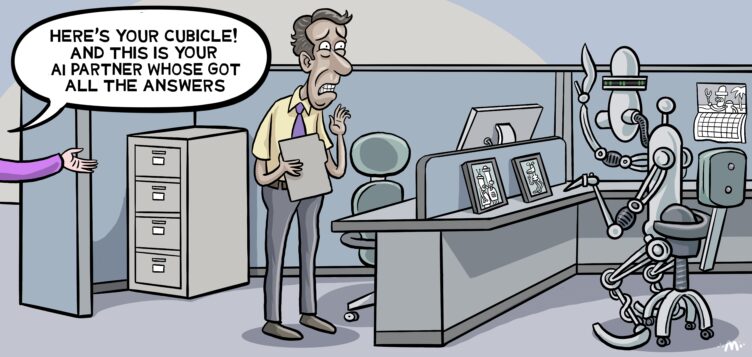
Artificial intelligence (AI) is reshaping service industries before our very eyes. In the space of a few short years, the technology has evolved from futuristic vision to vital business partner across a huge range of diverse functions: Parsing customer data for marketing insights, surfing currency markets with unprecedented agility, or balancing supply and demand logistics with uncanny foresight.
But what does AI – at heart a digital tool we usually access while sat at our desks – mean for more tangible industrial and manufacturing tasks? The kinds of tasks that generally take place on factory floors, engineering workshops or production facilities?
Thanks to emerging AI-driven technologies we are set to witness a similar revolution across physical processes, impacting everything from complex assembly to maintenance, inspection, packaging and more.
Recent advances in robotics and machine learning are enabling a new generation of hardware that can see, interpret, interact and react – a technological convergence that could prove game-changing in factories and on production lines globally.
This is not a theoretical or even a near-future scenario. It is happening now, all around us, and already affecting bottom lines. Retailer Amazon, for instance, has cut delivery times by a quarter thanks to operating the world’s largest robotics fleet in its warehouses.[1] Taiwanese electronics manufacturer Foxconn, meanwhile, has secured 15% cost savings by using AI-infused robots to carry out precision tasks such as screw-tightening that were once the preserve of human beings with fine motor skills.
Which other manufacturing industries are feeling the impact of AI, and how ready are investors – and workers – to adapt to this dynamic new world?
Are tactile robots the future of manufacturing?
What happens when AI, typically manifesting at the scale of the electron, is merged with physical apparatus and can begin to interact with the world around it? The answer is an exciting new era in robotics and a profound period of uncertainty for traditional manufacturers.
Technological advances mean that tasks once considered too nuanced, intuitive or complex for automation are now within the capabilities of AI-driven machinery. This transformation is credited to the maturation of key pieces of software, such as sophisticated learning algorithms and high-definition visual analysis programs.
Yet none of this would have real-world implications without parallel breakthroughs in the physical dimension: Step forward a new breed of versatile components, such as tactile sensors and ultra-soft grippers, allowing robotic appendages to interact with everyday objects.
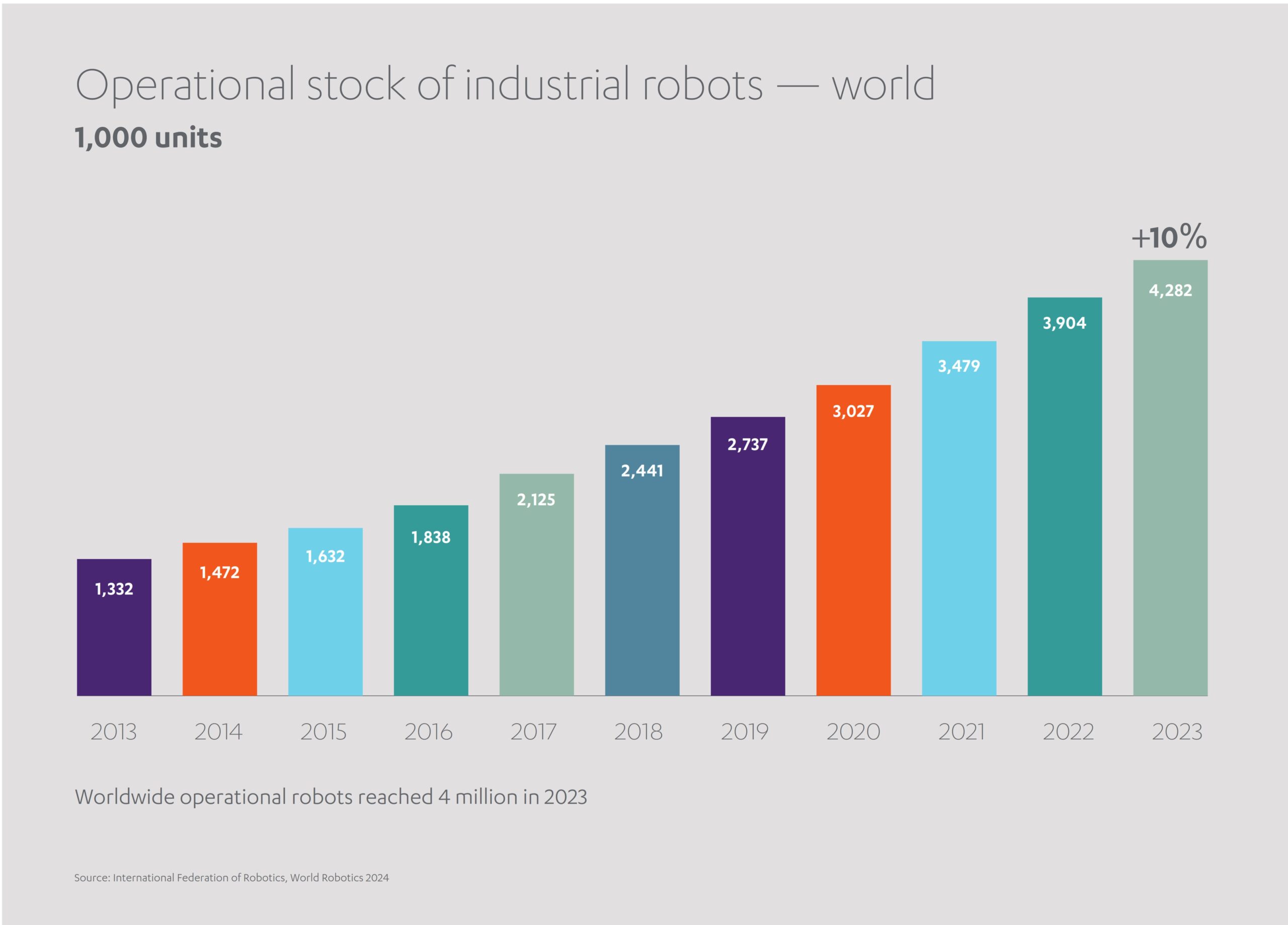
It is an exciting growth market which industry leaders are keen to explore. As of 2024 the number of industrial robots deployed in factories worldwide exceeded 4 million for the first time, registering 10% year-on-year growth.[2] Although the trend is global, regional pacesetters are emerging. Some 70% of all newly-installed robots in 2023 were in the manufacturing epicenters of Asia, notably China and Japan, with a further 17% appearing in Europe and 10% in the Americas.
What precisely are the key technologies underpinning such rapid progress in AI for industry?
- Perception: Robots on the factory floor can ‘see’ better than ever before. High-resolution cameras, plus light detection And Ranging (LiDAR) kit, create accurate visual inputs for appraising complex environments. Robots can now recognize objects, calculate their spatial location and comprehend their possible uses – a diverse skillset.
- Autonomy: Conventional robots are constrained to a narrow scope of actions. AI robots, in contrast, are programmed for intelligence, interpretation and innovation; they can ‘learn’ in simulated environments and transfer those skills directly to the production line, navigating unforeseen hurdles with the imagination and improvisation of a human mind. These abilities are already more advanced than many people realize. Google DeepMind’s Gemini Robotics, and Nvidia’s Isaac GR00T, already fuse vision, language and action to self-determine coherent workflows and achieve set goals with minimum human interference.
- Manipulation: AI-driven control software allows microscopic adjustments to grip/force-motors, enabling robots to clasp delicate items securely and interact with them deftly. Cutting-edge tactile sensors, capable of detecting pressure and slippage, can simulate an almost humanlike ‘touch’, massively broadening their deployment potential.
The merger of these technologies is ushering in the age of ‘context-based robotics’, whereby robots can perform tasks entirely autonomously without scenario-specific training – so-called ‘zero-shot learning’.
We are still early in our AI journey, but already it is apparent that few sectors are immune from radical change. Intelligent robotics are emerging across all manufacturing domains, with pioneers already benefiting from real-world applications.
Will robots replace humans on the factory floor?
In factories worldwide AI robots are already performing a number of tasks traditionally requiring human intervention.
- Materials: Robots are increasingly processing fresh components. They are mastering a number of technical crafts including adaptive welding (continuously adjusting voltage, current and travel speed to maintain joint consistency), as well as precision surface treatment using AI-enhanced vision.
- Construction: AI is proving itself capable of assembling complex units from varying parts, and handling modules with resistance-sensitive arms for extreme precision.
- Post-assembly: AI can avoid wastage by producing bespoke package sizes, and by arranging the items inside to maximize spatial efficiency.
- Support & logistics: Robots are performing supplementary roles too: Selecting preferred raw materials, carrying out defect detections, or taking care of routine maintenance tasks. By merging Third Millennium technology with that most historic of inventions – the wheel – we get mobile robots designed to move parts around factories for streamlined logistics.
As we shall see, AI is already proving itself an indispensable colleague in many real-world industrial scenarios.
Which companies are at the forefront of mechanized AI?
Amazon, the second largest company in the world by revenue[3], has devised a host of AI technologies for its fulfillment centers to achieve operational efficiencies.
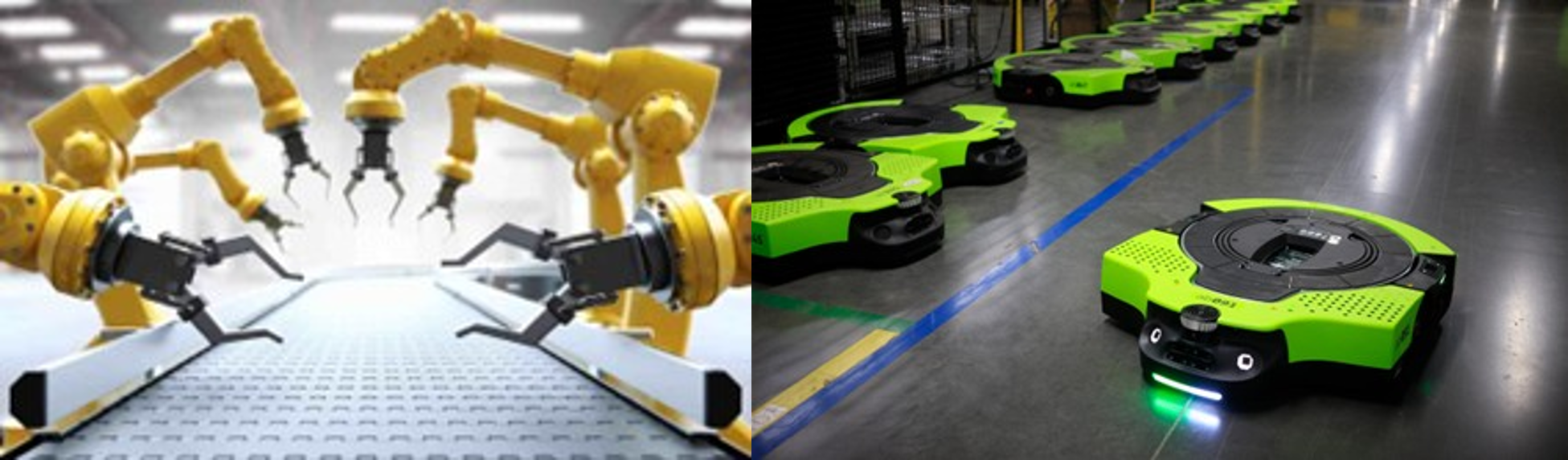
These innovations include ‘Sparrow’, a robotic arm with AI vision and motion technology for recognizing, picking and sorting 60% of Amazon’s warehouse inventory. ‘Proteus’ is equally impressive, a mobile robot for flat-pack goods that can safely trundle alongside human counterparts without requiring segregated safety zones.
The results are quantifiable. Amazon’s AI roll-out at its depot in Louisiana, USA, led to 25% cost savings and 30% more skilled jobs in-house.[4]
Taiwan’s Foxconn uses the Nvidia AI platform and an arsenal of robotic arms to automate tasks, such as inserting cables, which have until now required dexterous fingers. To achieve the necessary accuracy, Foxconn combines precision-control force-feedback technology with ‘digital twin’ simulations (virtual replicas of real-world objects with data from sensors on the physical counterpart). Internal studies showed AI has cut defect rates by 25% while reducing running costs by 15%.[5]
BMW’s Car2X AI system is enabling vehicles to become active participants in their own assembly. The cloud-based system allows the exchange of live messages between car and production team, together with ongoing status reports and error flags. Car2X AI can report any physical flaws, such as faulty plug connections, for prompt remedy, or issue alerts for missing components. A second system, AIQX (Artificial Intelligence Quality Next) manages camera systems and sensors along the entire conveyor belt process. Since being introduced, Car2X and AIQX have reportedly cut vehicle defects by 60%.[6]
Rival carmaker Volvo Cars is likewise using AI to improve reliability. Its visually-equipped AI units use pattern-recognition software to extend product lifespans by inspecting tread-marks on tires and detecting fissures on subframes.
German multinational engineering giant Bosch is deploying AI along its production line for multiple tasks. An early adopter of AI, Bosch has filed more than 1,500 AI patents and by 2027 will have invested a further US$ 3 billion in AI innovation.[7] Bosch uses an ‘agentic AI’ network (autonomous parallel systems running with minimal human intervention) across its home appliance manufacturing depots. Synthetically-generated images aid the inspection of copper wires in electric motors, and provide quality assurance for high-pressure pumps. Additionally, the firm’s generative AI capacity has cut the roll-out period for new AI applications across its plants from half a year to just a few weeks, with up to seven-figure cost savings per location.[8]
ADNOC, the state-owned energy company of Abu Dhabi, uses AI-driven predictive maintenance tools across its oil and gas facilities. It combines live monitoring with an analysis of historical component data to intervene before breakdowns occur. ADNOC uses AI across more than 2,500 pieces of heavy-duty equipment, from turbines and motors to centrifugal pumps and compressors.[9]
With warehouse space at a premium AI is also starting to demonstrate its prowess at optimizing stock levels by gauging demand, storage costs and lead times. American energy technology company Baker Hughes introduced C3.ai software to harmonize its inventory, reducing stockpiles of parts, raw materials and finished goods by 10-35% and triggering a 5-15% decline in shipping costs.[10]
Sports goods manufacturer Adidas, meanwhile, has embraced AI as a means of encouraging personalization. Digital customization platforms allow potential customers to define their own color schemes, text, materials and patterns. AI feeds these inputs to automated production lines, clustering optimizations to streamline workflow and cut machine downtime. Thanks to these tools, Adidas was able to raise revenue per user by 18.5% in just one month.[11]
These concepts will increasingly merge in the form of ‘smart factories’, with largely automated production lines and AI software matching raw materials to data-driven supply-and-demand decisions.
How are smart factories leading the transformation to Industry 4.0?
Hyundai’s Metaplant, based in Georgia, USA, is one of the world’s leading so-called ‘smart factories’.
The factory, described as robot-assisted yet human-centered, builds more than 500,000 vehicles annually. It relies on more than 850 robots and almost 300 Automated Guided Vehicles (AGVs) to carry out assembly work and convey parts around the plant.
To further increase productivity at the 2,900-acre site, Hyundai plans to order thousands of additional robotic units from leading designer Boston Dynamics. Key models include Boston Dynamic’s Spot, a canine-inspired machine which can perform vehicle inspections, and Atlas, a humanoid robot with a full range of dynamic manipulation tools.[12]
With such a vivid display of potential it is little surprise we are entering the age of the ‘cobot’ – collaborative robots designed to work safely alongside human operators in a shared workspace.
Delta’s versatile D-Bot, for example, can already juggle multiple tasks from welding to packaging and quality control. A single D-Bot unit can be assembled in an hour and handle payloads up to 30 kilograms.
Future iterations of smart robots should be able to learn from their own errors, understand human speech, and even synthetically generate their own form of verbal communication.
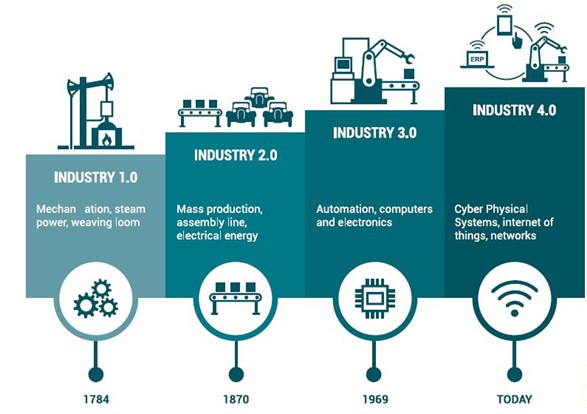
All of these are hallmarks of the much-discussed Industry 4.0 or Fourth Industrial Revolution – the fusion of smart manufacturing and intelligent factories.
With the roadmap to wider adoption scattered with challenges, industry leaders must start preparing their businesses today for the age of AI.
What could derail the robot revolution?
Early signs suggest that embracing AI can help drive industries towards profitability, reducing costs by over 60% and boosting productivity by more than half.[13] Yet a raft of challenges lie in wait to derail swift adoption.
Physical AI, like large language models, needs massive amounts of data from which to learn and hone performance. Robotics data is expensive and scarce, however, since it is accrued in the real rather than the digital world.
One possible solution lies in ‘synthetic data’ – artificial data created by generative AI that copies the patterns and structure of real-world data. Photorealistic rendering, with variable light levels and textures, is already used to train robots how to manipulate physical objects.
Functioning within real-world environments, particularly alongside flesh-and-bone colleagues, presents further challenges. Safety is a top priority, yet spatial awareness remains problematic for industrial AI, just as it does for self-driving cars. Promisingly, Vision-Language-Action (VLA) models are beginning to appear on the market, capable of perception, reasoning and control. These programs herald unprecedented powers of spatial awareness for robots in factories and warehouses, even in unstructured environments with unpredictable human interaction.
3D spatial perception, vital for improving manual dexterity, is currently limited by mechanical and sensory constraints. However, this is likely a temporary handicap. As computers develop greater understanding of the variables involved in physical-world interaction (such as object geometry and angle) they will be come to operate with far greater fluidity, gradually mastering more tasks beyond their current remit.
Given these challenges, maximizing the potential of mechanized AI into a groundbreaking economic opportunity will require complementary technical and organizational strategies from both public and private sectors.
What are the social benefits of industrial AI?
The World Economic Forum highlights a series of priority steps to help prepare industries – and economies – for the coming wave of physical AI.
- Incorporating AI technology into the current industrial ‘toolchain’ (development tools used to design and build software)
- Developing partnerships across robotics, AI and manufacturing to ensure scalability and compatibility as the technology evolves
- Upskilling the workforce to ensure efficient human-machine collaborations and to fill new careers such as AI coaches and system optimizers
Legislative support will also be vital, but here we see encouraging signs of progress. The USA is running targeted federal programs such as NIST’s Manufacturing USA institute, specifically focused on improving AI for manufacturing. Similarly, the Advanced Manufacturing Technology (MFGTech) initiative aims to boost automation and safety on production lines. In the Middle East, Saudi Arabia’s National Strategy for Data and Artificial Intelligence earmarks US$ 20 billion investment to establish 200 AI startups and train upwards of 20,000 data and AI specialists.[14]
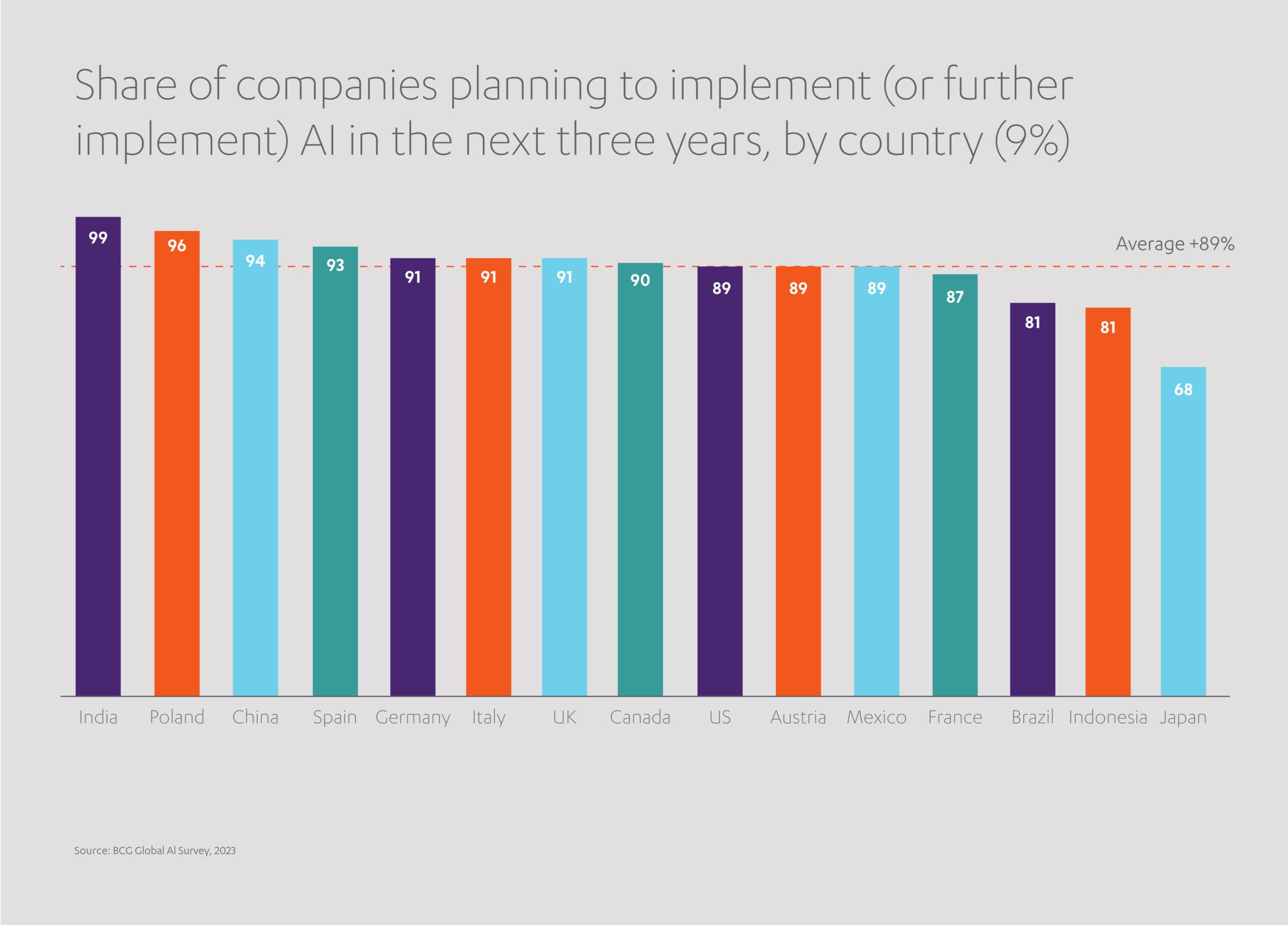
However we appraise the current manufacturing market, it is clear that AI-driven change is coming. Studies show a high appetite for AI infusion across industrial operations. Nine-in-ten companies across Asia, Europe and the Americas are planning to introduce AI to their production processes within the next three years.[15] Early adopters are seeing tangible production benefits, with an average of 14% savings on traditional manufacturing costs.
The technology, meanwhile, continues to develop with relentless momentum. In August 2025, Google DeepMind achieved a historic AI breakthrough by winning a gold medal for solving a complex real-world problem at the renowned International Collegiate Programming Contest (ICPC) World Finals in Azerbaijan. Google’s Gemini 2.5 AI model took less than an hour to consider an infinite number of possibilities and distribute liquid through a set of ducts as quickly as possible – beating accomplished human programmers in the process. Google hailed it as “a historic moment towards artificial general intelligence”.[16]
In a fast-changing sector AI offers manufacturers a way to stay competitive and profitable. If nurtured with ambitious investment AI could become as transformative for the manufacturing sector as it has been for service industries.
The rewards could be social as well as financial. Technological breakthroughs open avenues for greater efficiency while liberating people to focus on more productive, rewarding and distinctly human workplace challenges.
[2] https://ifr.org/ifr-press-releases/news/record-of-4-million-robots-working-in-factories-worldwide
[3] https://fortune.com/ranking/global500/
[4] https://reports.weforum.org/docs/WEF_Physical_AI_Powering_the_New_Age_of_Industrial_Operations_2025.pdf
[5] https://reports.weforum.org/docs/WEF_Physical_AI_Powering_the_New_Age_of_Industrial_Operations_2025.pdf
[6] https://www.chiefaiofficer.com/post/bmw-ai-quality-control-60-percent-defect-reduction-manufacturing
[7] https://metrology.news/bosch-set-to-revolutionizing-manufacturing-with-agentic-ai-in-industrial-technology/
[8] https://www.bosch-presse.de/pressportal/de/en/bosch-to-use-generative-ai-in-manufacturing-260806.html
[9] https://adnoc.ae/en/news-and-media/press-releases/2019/adnoc-embarks-on-one-of-the-largest-predictive-maintenance-projects
[10] https://www.bakerhughes.com/bhc3
[11] https://useinsider.com/case-studies/adidas/
[12] https://www.newsweek.com/hyundai-motor-group-boston-dynamics-robots-manufacturing-2060286
[13] https://www.strategyand.pwc.com/de/en/functions/digital/ai-across-industries.html
[14] https://www.kearney.com/service/operations-performance/article/ai-in-manufacturing-how-the-technology-is-poised-to-revolutionize-the-industry-and-its-players
[15] https://www.bcg.com/about/partner-ecosystem/world-economic-forum/ai-project-survey
[16] https://www.theguardian.com/technology/2025/sep/17/google-deepmind-claims-historic-ai-breakthrough-in-problem-solving


 Added to press kit