Could drug resistance in livestock be a threat to global welfare?



The impact of antimicrobial resistance (AMR) on human health is real and dangerous. But drug resistance in humans is only part of the story. AMR in farm animals has the potential to be equally devastating not only for animal health, but also global nutrition, rural economies and the financial security of an industry responsible for the livelihood of 1.3 billion people.[1]
Farm animals act as unintentional petri dishes for all kinds of undesirable strains of superbugs. Up to 50% of pigs in European farms, for example, are now believed to be carriers of MRSA.[2]
To combat this, antimicrobial drug use has grown more than 50% over the past 20 years, particularly in developing economies, where regulation and oversight are often weaker. Worldwide, around 70% of all antimicrobial drugs are used within the livestock sector. Currently, around 100,000 tons of antimicrobials are dispensed annually, but that figure is expected to rise to around 140,000 tons by 2040[3],[4] as global population growth fuels increased demand for meat and animal products.
Case study: Chickens cause salmonella spike in USA
Hundreds of people across multiple US states were hospitalized in 2025 with crippling diarrhea, fever and vomiting. They tested positive for salmonella, a potentially fatal bacteria infecting the intestine. Worse, the strain was resistant to the hospital’s first-line antibiotics such as Fosfomycin. Two died. Lifestyle investigations indicated the disease had crossed to humans from backyard flocks of chickens.
It is a natural feature of evolution that the increased use of antimicrobials means a greater likelihood of resistance developing. Given environmental exposure, previously vulnerable microbes (bacteria, virus, fungi, or microscopic parasites) will gradually become immune to the drugs which once eradicated them.
Studies suggest that the continued spread of AMR could lead to a fall in global livestock levels of up to 8% by 2050, or 11% in low-income countries where food production is already challenging.[5]
How have we allowed the health of our livestock to suffer, and our global food systems to become so threatened?
Why are we so dependent on antibiotics?
If antibiotics are causing a problem, why don’t we just use less of them? As a notion, this reasoning sounds ingenious in its simplicity. Yet, the reality is more complex.
Antibiotics are the lynchpins of modern medicine, treating infections either by killing bacteria directly or by stopping them from multiplying. Among human patients we use them for:
- respiratory infections such as bronchitis or pneumonia
- infected cuts
- sexually transmitted diseases
- urinary and bladder infections
- and other serious illnesses such as meningitis
Sometimes they are used preventatively, if people have low immune systems or are awaiting surgery, or they are prescribed post-infection to aid the body’s natural defenses.
For human and animal subjects alike, common antibiotics include:
- penicillins such as Amoxicillin
- cephalosporins, for sepsis
- macrolides, for pneumonia
- and fluoroquinolones, for recurrent infections
Among animal populations, precautionary antibiotics are often dispensed to entire flocks or herds via drinking water and feed. While prevention is doubtless better than cure, this prophylactic approach inevitably leads to a situation of over-prescription. With good intentions, we can accidentally encourage naturally-occurring bacteria to mutate and become tomorrow’s drug-resistant infections.
What are the dangers of ignoring the threat of AMR?
AMR isn’t some hypothetical issue for a future date – we are already living with the impacts today. In the absence of effective antibiotics we cannot properly treat infected animals, which in turn causes needless suffering and premature death, with much wider implications for humankind.
Failing to tackle the issue of AMR globally could carry a US$ 100 trillion cumulative cost to economic output by 2050
Strains of drug-proof E.coli, campylobacter and salmonella have already been detected among poultry stocks worldwide, resulting in stunted growth and mass culls.[6]
Pig farmers are likewise reporting more cases of antimicrobial-resistant swine dysentery, a highly contagious and severe mucohemorrhagic disease spread via contaminated feces, rats or equipment.
Case study: Drug-resistant livestock fuel MRSA outbreak in UK
During the Covid lockdown in the UK, a dozen patients aged 22 to 70 receiving treatment in a burns unit had their wounds infected by Staphylococcus aureus – better known as MRSA.
Several failed treatments later, it became apparent that the strain was livestock-derived and resistant to the antibiotic Methicillin, drastically limiting intervention options. All patients survived, but it was never confirmed how MRSA had entered the facility.
Conventional antibiotics are already proving inadequate in many cases, so farmers are increasingly turning to pleuromutilins, stronger antibacterials which bind to a different site on the bacterial ribosome. However, even pleuromutilins are facing growing bacterial resistance, risking substantial loss of stock. Swine dysentery can leave a trail of devastation in its wake, with 90% morbidity and 30% mortality rates among infected herds.[7]
Inaction is a luxury we cannot afford. Failing to tackle the issue of AMR in livestock globally could carry a US$ 100 trillion cumulative cost to economic output by 2050 via a 3.8% reduction in annual GDPs.[8] In worst case scenarios, if all antibiotics fail due to bacterial mutation, the price will be paid in human lives.
Why does livestock AMR matter beyond the farm?
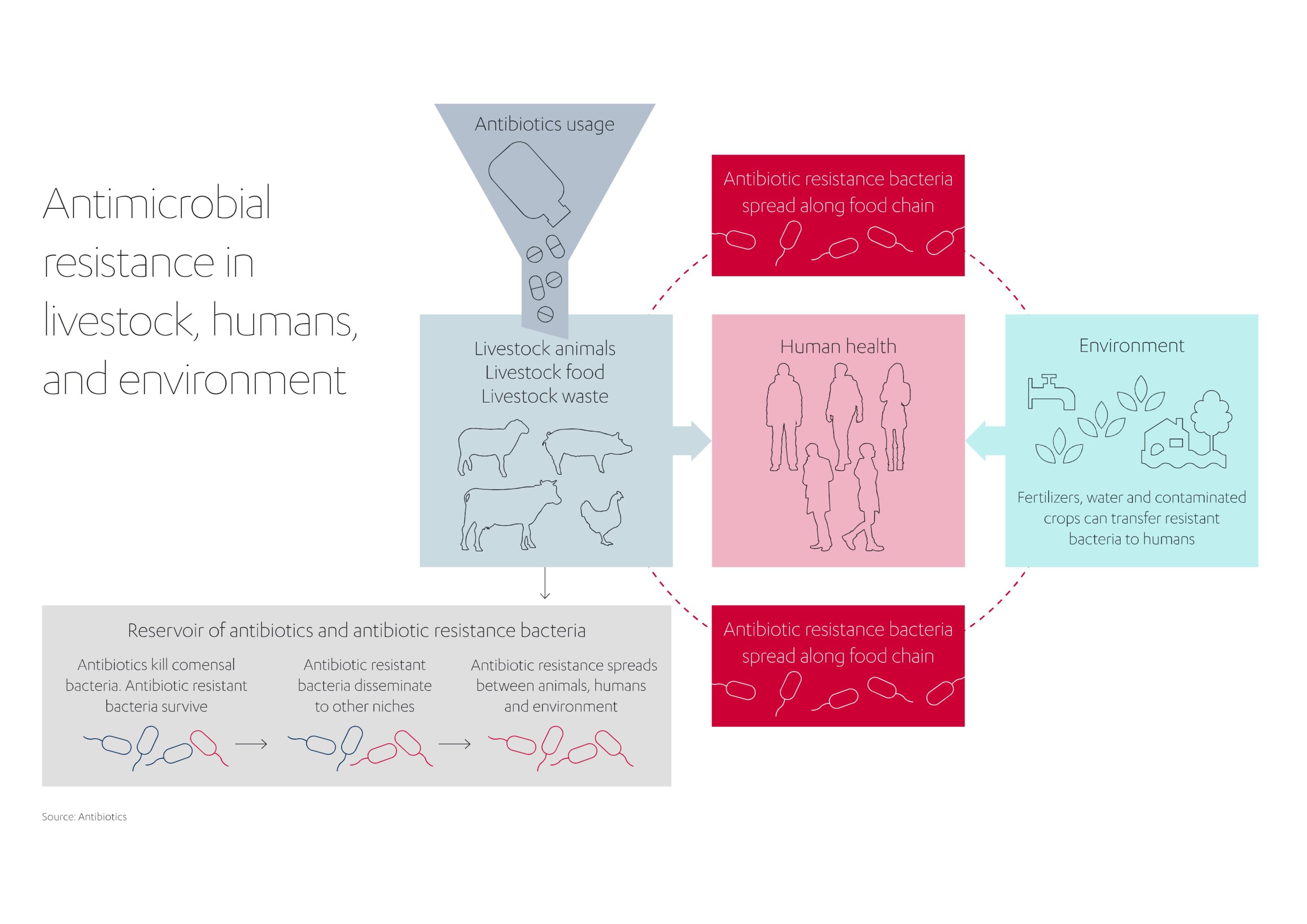
The impact of AMR in livestock does not stop at the farm gate. It moves through food systems, health systems, ecosystems and economies, which is why AMR is increasingly understood as a ‘one health’ challenge: a problem in which human, animal, plant and environmental health are inseparable.
For animals, the consequences are immediate and visible. When common infections become harder to treat, livestock suffer for longer, mortality rises and farmers face higher veterinary costs, lower productivity and greater losses. In severe cases, resistant infections can contribute to culls, disrupt breeding programmes and reduce the availability of safe, affordable animal protein. For families and communities dependent on livestock, the issue is therefore not simply one of animal health, but of income, nutrition and resilience.
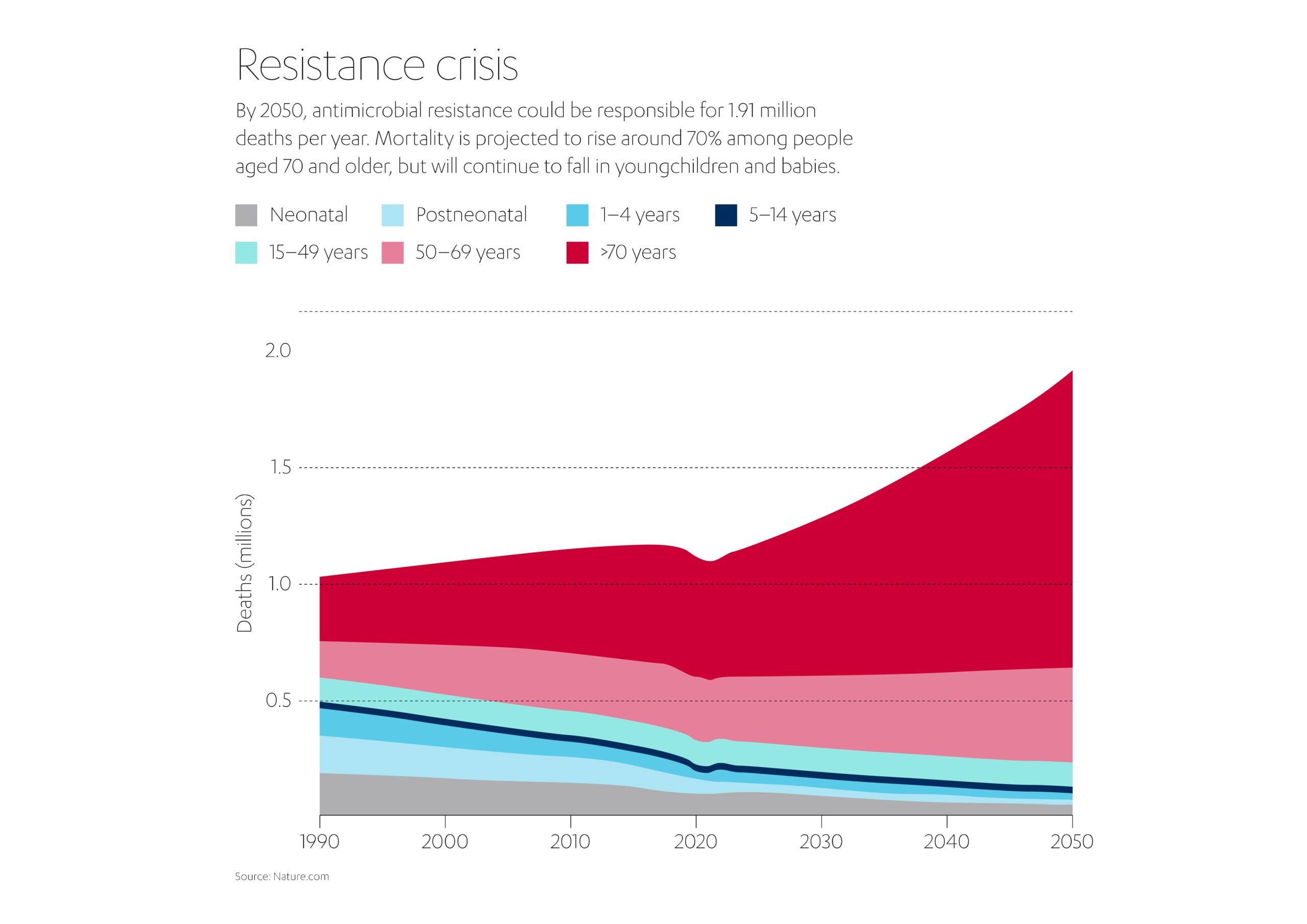
Resistant bacteria can reach humans through direct contact with animals, contaminated food, manure, soil, water and the wider environment. Once resistant organisms enter human populations, they can make everyday infections more difficult to treat and increase the risks associated with surgery, cancer care, childbirth and intensive care. Global analysis in The Lancet estimates that, without stronger action, AMR could be directly responsible for 1.91 million deaths a year by 2050, with 8.22 million deaths associated with AMR annually.[9]
There’s a huge social cost, too. The World Bank warns that unchecked AMR could push 28 million people into poverty. Modelling suggests that losses linked specifically to AMR in livestock could cost global GDP up to US$950 billion, while the spread of resistant pathogens from livestock to humans could cost up to US$5.2 trillion.[10] These figures underline the scale of the challenge: AMR can weaken healthcare systems, disrupt trade, increase household medical costs and place additional pressure on countries already facing food insecurity.
AMR also poses a considerable risk to the environment. Antimicrobial residues and resistant bacteria can enter soil and waterways through manure, agricultural runoff and aquaculture systems. The FAO notes that 75% to 90% of tested antibiotics may be excreted from animals unmetabolized, creating further opportunities for resistant organisms to persist and spread.[11]
Seen in this light, responsible antimicrobial use in animals has a much broader impact than protecting animals themselves. Healthier animals require fewer medicines; stronger biosecurity reduces infection pressure; better surveillance helps contain outbreaks earlier; and improved waste management limits environmental contamination. Tackling AMR in livestock means safer food, more resilient farming, lower healthcare risk and greater long-term economic stability.
If the consequences of AMR stretch across farms, hospitals, food systems and ecosystems, then the response must be equally connected. This begins with a clearer understanding of where resistance is emerging, how it spreads, and which interventions can reduce the need for antimicrobials without compromising animal welfare or food security.
What can we do to reduce drug resistance?
Although AMR resistance is a growing threat worldwide, there is no central body to monitor outbreaks and capture the declining performance of traditional drugs.
How can we effectively counteract AMR if we fail to comprehend its frequency and severity?
Online AMR database resistancebank.org aims to address this deficiency by collating hundreds of AMR in livestock reports spanning Europe, Asia, Africa, North America and South America.
However, it is far from comprehensive, restricting itself only to instances where AMR rates in livestock surpass 50%, and is constrained by inconsistent sampling across different territories.
AMR Facts and Figures
- 3 billion people depend on livestock and agriculture for their livelihoods
- 70% of all antimicrobial drugs globally are used in livestock
- 140,000 tons of antimicrobials used annually by 2040, up from around 100,000 tons today
- 8% of global livestock could be lost by 2050 due to AMR, rising to 11% in low-income countries
- 91 million deaths a year directly attributable to AMR by 2050
- 28 million people could be pushed into poverty by unchecked AMR
- US$ 950 billion in livestock-related losses due to AMR
- US$ 5.2 trillion cost of drug-resistant pathogens passing from livestock to humans
- 90% morbidity and 30% mortality of swine dysentery due to AMR in affected herds
The World Organization for Animal Health describes AMR as “one of the greatest global health challenges of our time”.[12] Yet it emphasizes that all is not lost, with several strategies emerging to curb the further proliferation of dreaded superbugs.
“One of the greatest global health challenges of our time” – the World Organization for Animal Health on antimicrobial resistance
Surplus antibiotics, leaching from farmyards into our soil and waterways, encourage resistant bacteria to form in the wild. Even its presence in manure can spread to the wider landscape, because animal waste is often used as agricultural fertilizer. Those working in the industry can therefore help limit the problem by being precise about the amount of drugs they dispense and ensuring that any leftover medicines are disposed of responsibly. Clean disposal techniques should be applied to animal waste products and any other industrial runoff which may have come into contact with antimicrobials.
Secondly, we can try to limit livestock disease outbreaks by focusing on hygienic conditions for farm animals. Good animal management is pivotal, including:
- quarantining newly arrived animals before integrating them into herds
- limiting visitor numbers to farms
- using disinfectant feet trays
- restricting access to grazing land
- routinely disinfecting vehicles, tools and equipment
- and controlling pests and other wildlife that might raid feed troughs and spread bugs further
Additionally, farmers should design tailored vaccination programs in association with specialist vets, ensuring effective herd immunity without wasteful over-use. Animals must be inspected daily for signs of illness and immediately segregated if suspicious traits are detected. Carcasses must be promptly removed and disposed of to prevent other creatures coming into contact with them.
Regular testing can help to identify individual cases of AMR disease before they become outbreaks
Further, pastoral farmers should use mains water instead of streams and ditches for hydrating their animals, since mains water has been chemically treated and its provenance assured. Slurry should not be spread on pastureland during grazing periods. Regular testing can help to identify individual cases of AMR diseases before they become outbreaks. Biosecurity plans should be kept up-to-date and detail appropriate responses in the event of disease detection: Informing relevant authorities promptly and maintaining full records of animal movements to aid with traceability.
Some agricultural and nutritional experts are beginning to look beyond the remit of antimicrobials, instead promoting a more holistic approach to animal health. Some are turning to probiotics – live microorganisms such as bacteria or yeast – to boost gut flora, improve natural immunity and support sustainable health in livestock.
Whichever tactic one favors, the financial freedom of the private sector is integral to resolving the AMR issue worldwide. An exciting new collaboration between US university MIT and Jameel Research, part of the Abdul Latif Jameel International network, demonstrates the power of partnerships for bolstering the robustness of livestock worldwide.
Can the private sector use AI to combat rising drug resistance?
In January 2026, Jameel Research announced it was funding a new project at MIT’s Department of Biological Engineering to combat AMR.

The ambitious three-year project is headed by Professor James J. Collins, Termeer Professor of Medical Engineering and Science at MIT and Faculty Lead for Life Sciences at the MIT Jameel Clinic, which serves as MIT’s central hub for AI and healthcare innovation.
Professor Collins and his team are working to create a new generation of antibacterial treatments and rapid diagnostic tools. Combining synthetic biology with advanced generative AI, the project aims to accelerate results and target antibiotics where they are most effective.
‘Minibinders’ would be delivered through modified microbes to neutralize critical toxins and protein targets
The initial phase focuses on developing and validating programmable antibacterial therapies intended to tackle AMR across a variety of bacterial pathogens. These so-called ‘minibinders’ would be delivered through modified microbes to neutralize critical toxins and protein targets.
This new strategy for developing antibiotics represents a significant step toward the long-term goal of creating programmable treatments to overcome AMR in both livestock and humans. In the future, this approach could also enable the faster development of medical countermeasures for emerging and re-emerging pathogens, improving the global response to outbreaks.
“Antimicrobial resistance is one of the most urgent challenges we face today and addressing it will require ambitious science and sustained collaboration,” said Professor Collins. “This project reflects my belief that tackling AMR requires both bold scientific ideas and a pathway to real-world impact.
“We’re pleased to support this new research, building on our longstanding relationship with MIT and our commitment to strengthening global health and contributing to a more resilient future.”
“We’re pleased to support this new research, building on our longstanding relationship with MIT and our commitment to strengthening global health and contributing to a more resilient future” – Professor James J. Collins
While we await the miracles of modern medicine and technology, we must remain vigilant in our attitude to AMR. We must accept that we cannot stop pathogens from adapting to their environment and developing resistance to antibodies. Evolution is, after all, the same process by which humankind has become such a comfortable fit for the world.
Acceptance does not, however, mean inaction. Instead, we must focus our efforts on supporting a vibrant ecosystem for cutting-edge AMR research, while adopting sustainable farming practices to delay the adaptation process as much as possible.
By protecting the effectiveness of antimicrobials in livestock today, we also help protect future medical care, food security, environmental health and the economic resilience of communities worldwide.
This twin strategy offers the best chance of making a lasting difference to the health of global livestock, while protecting agricultural economies and food production for future generations.
Five fast facts
Q: How widespread is the problem of infectious diseases among livestock worldwide?
A: Up to 50% of pigs in European farms are now believed to be carriers of MRSA, a type of staph bacteria resistant to many common antibiotics.
Q: Could AMR damage global livestock levels?
A: Studies suggest that the continued spread of AMR could lead to a fall in global livestock levels of up to 8% by 2050.
Q: Are farms using too many antibiotics?
A: Antimicrobial use has grown more than 50% over the past 20 years, and around 70% of all antimicrobial drugs are now consumed by the global livestock sector.
Q: Why is AMR in animals also a threat to wider society?
A: Resistant bacteria can spread through food systems, direct animal contact, manure, soil and water, increasing the risk of harder-to-treat infections in humans.
Q: What could AMR cost the global economy?
A: The World Bank estimates that unchecked AMR could wipeout 3.8% of global GDP each year by 2050 and push 28 million people into poverty.
[1] https://www.fairr.org/news-events/insights/amr-material-risks-animal-health
[2] https://www.sciencedirect.com/science/article/abs/pii/S0195670121004357
[3] https://www.fairr.org/news-events/insights/amr-material-risks-animal-health
[4] https://www.nature.com/articles/s41467-025-56825-7
[5] https://www.fairr.org/news-events/insights/amr-material-risks-animal-health
[6] https://www.fairr.org/news-events/insights/amr-material-risks-animal-health
[7] https://www.fairr.org/news-events/insights/amr-material-risks-animal-health
[8] https://www.fairr.org/news-events/insights/amr-material-risks-animal-health
[9] https://www.thelancet.com/journals/lancet/article/PIIS0140-6736%2824%2901867-1/fulltext
[10] https://www.worldbank.org/en/topic/health/brief/antimicrobial-resistance-amr
[11] https://www.fao.org/one-health/areas-of-work/antimicrobial-resistance/en
[12] https://www.woah.org/en/what-we-do/global-initiatives/antimicrobial-resistance/


 Added to press kit