Why does drought keep escalating despite the strong case for prevention?



Drought has traditionally been treated as a localized, seasonal problem: an agricultural setback to be endured in a difficult year and recovered from in the next. That framing no longer reflects reality. The area of land affected by drought has doubled since 1900, and around 40% of the world’s land surface now experiences more frequent and more intense dry spells[1], with knock-on effects on food security, energy generation, trade and public health. The persistence and growing severity of these impacts point to a deeper question about how societies anticipate, finance and manage water risk.

Chief Executive Officer
Almar Water Solutions
Carlos Cosín, Chief Executive Officer, ALMAR Water Solutions (part of Jameel Environmental Services), argues that the central failing is the outdated approach taken to water risk: water systems are still managed reactively, responding to drought once it arrives, rather than proactively building resilience long before reservoirs run low.
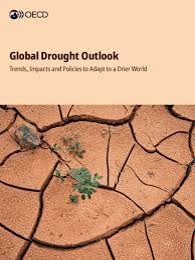
Drawing on the findings of the OECD‘s Global Drought Outlook, he believes that drought has become a systemic, cross-sectoral risk that must be priced, planned for and engineered against in advance.
As climate pressures intensify, Carlos says the response to drought will increasingly define the economic stability, sustainability and integrity of the societies managing it.
The response to drought will increasingly define the economic stability, sustainability and integrity of the societies managing it.
ALMAR Water Solutions, part of Jameel Environmental Services, is on the frontline of this evolving environment. ALMAR was established in 2016 with a mission to improve the world’s water security, particularly for the most vulnerable global communities. A decade later, it manages a portfolio of desalination, wastewater treatment, reuse and recycling programs. With a growing portfolio of projects across Europe, the Middle East, Latin America, Africa, and Asia-Pacific., ALMAR designs, structures financing and operates systems across the full water cycle – from desalination and purification to wastewater treatment, reuse, distribution networks, and long-term operation and maintenance.
In this Q&A, Carlos reflects on why drought has become so difficult to confront, why water remains chronically undervalued, and what a shift from reactive crisis management to long-term resilience would require of governments, industry and finance.
Q: The OECD’s Global Drought Outlook puts drought near the top of the climate-risk list. Why do you think it may be the hardest of these threats to confront?
 Drought is hard to confront because it’s so easy to miss.
We frequently experience dramatic climate disruptions that have a sudden, visible impact, but drought doesn’t work like that.
A hurricane or a flood announces itself immediately. A drought just quietly settles in.
The land dries out, livelihoods erode, economies suffer and ecosystems start to fail, and none of it comes with a single dramatic moment you can point to. Water scarcity is a much bigger problem than drought alone, but drought is the part ordinary people actually feel.
As the OECD report makes clear: this isn’t some worrying future scenario. It’s happening right now, all around us.
Drought: What are the numbers that matter?
- Drought affects 40% of the world’s land surface more frequently and more intensely.
- The area affected by drought has doubled since 1900.
- Drought causes more than a third of disaster-related deaths.
- The average drought event now costs more than twice as much as in 2000.
- 70%of global water withdrawals go to irrigation.
- 62%of monitored aquifers are seeing groundwater declines.
- Every US$ 1 invested in drought prevention can return up to US$ 10 in benefits.
Q: How can the water industry take action to address this?
The report is a warning to all sectors of society, and especially to those of us in the business of water. Addressing this problem requires a fundamental shift: from reactive crisis management to proactive resilience-building. We have to change how we operate: stop waiting for the crisis and start building resilience before it hits. ALMAR has spent a long time designing water systems across different continents, and I’m convinced this is a moment we can’t afford to waste. How we respond to drought will define the moral, economic and environmental integrity of our society.
Q: You say drought has outgrown its old definition. How has it changed?
Drought used to be filed under agriculture, a problem for farmers in a bad year. That’s no longer true. Drought now impacts almost every sector at once. The OECD’s numbers tell the story: the area of land affected has doubled since 1900, and today 40% of the planet’s land surface is seeing more frequent and more intense dry spells. If global warming keeps accelerating, these extremes could be up to seven times worse under a four-degree scenario.
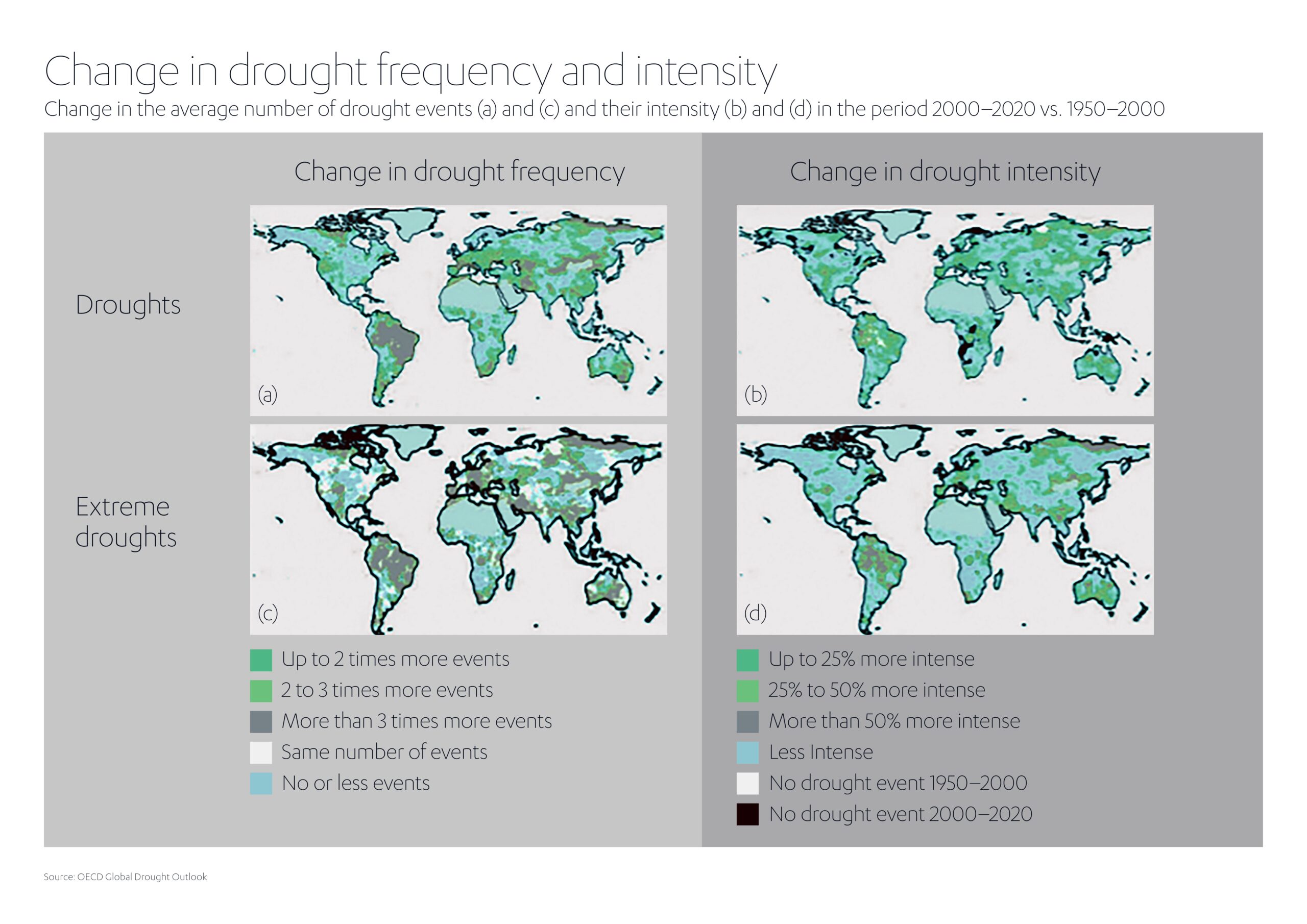
Q: Can you put the human and economic impacts into perspective?
In human terms, the numbers in the OECD report are startling. Drought causes more than a third of all disaster-related deaths, even though it makes up only about 6% of natural disasters. California lost over a billion dollars in agriculture in 2021 alone. Five straight years of failed rains in the Horn of Africa pushed 23 million people into hunger. And the knock-on effects: power cuts at hydroelectric dams, ships unable to pass through the Panama Canal, food prices climbing, are no longer one-off events, they are what the ‘new normal’ looks like.
The financial side is just as stark. The OECD estimates the average cost of a single drought has more than doubled since 2000, and expects it to climb by at least another 35% by 2035. There are some of the consequences of our failed approach to water systems management: acting too late, governing in silos and never putting enough money into resilience.
The OECD estimates the average cost of a single drought has more than doubled since 2000, and expects it to climb by at least another 35% by 2035.
Q: What are the main contradictions you see in how we treat water?
It’s something I’ve come back to again and again in this job: nothing matters more than water, and yet we price it as if it barely matters at all. The evidence is everywhere. Irrigation alone takes 70% of the water we withdraw, and a lot of that is wasted. Groundwater is falling in 62% of the aquifers we monitor. And as cities pave over more and more ground, rainwater can’t soak back down to refill those aquifers, something that’s quietly happening right across the OECD.
Q: Where are policy frameworks falling short?
Policy hasn’t caught up with any of this. In Europe, the charges for taking water out of the system cover only 2% to 3% of what scarcity actually costs. Plenty of countries still hand out water according to rights set generations ago, as if the climate weren’t shifting under their feet. You can’t keep running a system where outdated rules ignore the physical reality.
Q: So what needs to change?
Being honest about the numbers and fixing how we price water are the obvious places to start. But in truth, we need something deeper. We need to change how we think about water altogether: to treat it as something we look after rather than simply consume, and to leave enough in rivers and wetlands for them to keep functioning. Right now we treat it as just another input we buy, when really it’s part of the infrastructure that keeps us resilient. This has to change.
Q: The OECD report is sobering, yet you’ve called part of its message hopeful. Why?
The report isn’t just a long list of problems and risks. It also sets out clear strategies for addressing these issues and transforming our whole approach to water management. The overarching messages is that resilience is achievable. But it won’t come from engineering alone, however much engineering matters – and as an engineer, I don’t say that lightly. It needs joined-up thinking, cooperation between sectors that don’t usually talk to each other, and leaders willing to make unpopular decisions early.
The framework the OECD sets out is close to how we already work: understand the risk, cut your exposure to it, and build the capacity to respond when it hits. Every one of these takes investment, and not only money. It takes some imagination about how we solve the problem in the first place.
We have to stop treating resilience as someone else’s problem, a cost to be pushed off the books.
Q: What’s the business case for investing in water resilience?
We have to stop treating resilience as someone else’s problem, a cost to be pushed off the books. The OECD found that every dollar put into drought prevention can return as much as ten dollars further down the line. For a business, that isn’t abstract. It means fewer shocks, supply chains that hold up, communities that trust you to operate, and value that lasts.
Q: Is this a problem for the water industry alone?
No, the water industry can’t fix this problem on its own. Governments have to set clear rules that don’t change every few years, line up incentives so the economics work, and use public money to take some of the early risk off private investment. Banks and investors need to start treating water risk as something that genuinely shows up on the balance sheet. And internationally, drought has to be written properly into climate adaptation funding, in a way that’s both organized and fair to the countries bearing the worst of it.
Q: Where does equity fit into a credible drought strategy?
None of this holds together as a strategy unless we’re honest about who pays. The people hit hardest by water stress tend to be the poorest and the most overlooked, and they’re the ones who did least to cause it. Sub-Saharan Africa has the highest death rates from drought. Farm workers across Latin America and South Asia often have no access to even basic ways of adapting.
A fair transition can’t just mean clever, expensive systems for wealthy cities. It has to mean safe, dependable water reaching the communities that don’t have it. And it means accepting that our health and the health of natural systems are bound up together. Wetlands, forests and river corridors aren’t a nice-to-have. They keep us alive.
A fair transition can’t just mean clever, expensive systems for wealthy cities. It has to mean safe, dependable water reaching the communities that don’t have it.
Q: You call the OECD report ‘a mirror’. What does it show us, and what should we do about it?
I call it a mirror because it shows how we truly are, how fragile we are, and at the same time what we’re capable of if we choose to act. I take it personally; as both a warning and a job to be done.
If we get water resilience right, it benefits the whole of humankind: food, energy, health and even geopolitical stability all depend on it. Yet we keep treating it as tomorrow’s problem.
What we need now is a real agreement between government and business, between the engineers and the ecologists, between the wealthier global North and the global South that’s often on the frontline of these changes. The report has done the hard work of seeing the situation clearly; it would be a waste if we look away from it. We can meet this with despair, or we can meet it with ambition and resolve. I know which I’d choose.
How do we get from crisis response to proactive resilience?
The escalating cost of drought reflects deeper weaknesses in the way water risk is anticipated, priced and governed. Building and upgrading water infrastructure remains essential. But long-term progress also depends on treating resilience as a core investment rather than an afterthought: integrating ecological flows, reforming how water is valued, and aligning public, private and international finance behind prevention.
As Carlos highlights above, the economics increasingly favor acting early, since every dollar invested in drought prevention can return up to ten in avoided losses. As climate pressures intensify, the question is less whether resilience is achievable than whether governments, industry and finance can move from managing drought as a recurring emergency to building systems designed to withstand it.
Global drought risk: Five fast facts
How much of the world’s land is affected by drought?
The area of land affected by drought has doubled since 1900. Around 40% of the world’s land surface now experiences more frequent and more intense dry spells.
How deadly is drought compared with other disasters?
Drought accounts for more than a third of disaster-related deaths, despite making up only around 6% of natural disasters.
Is the impact of drought becoming more expensive?
Yes. The OECD estimates the average cost of a drought event has more than doubled since 2000 and could rise by at least a further 35% by 2035.
How much water does irrigation use?
Irrigation accounts for around 70% of global water withdrawals, often inefficiently, while groundwater levels are falling in 62% of monitored aquifers.
Does prevention pay off?
According to the OECD, every dollar invested in drought prevention can yield up to ten dollars in long-term benefits.
[1] https://www.oecd.org/en/publications/2025/06/global-drought-outlook_28488e98.html


 Added to press kit